
How Digital Cargo Management Improves Visibility, Security, and Efficiency
Transportation companies operate in an environment where speed, visibility, accuracy, and accountability directly affect profitability. Whether it is full truckload movement, last-mile delivery, industrial logistics, or sensitive cargo transportation, every shipment needs to be tracked, documented, monitored, and delivered with minimal disruption.
Traditional cargo management often depends on phone calls, paper documents, manual updates, and delayed reporting. These methods may work for small operations, but they quickly become inefficient as shipment volumes grow. Delays, route deviations, misplaced cargo, inaccurate documentation, and poor visibility can create serious operational and financial problems.
This is where digital cargo management becomes important. By using GPS tracking, IoT devices, cloud dashboards, automated alerts, and real-time reporting, transportation companies can manage cargo movement more efficiently and securely. Digital cargo management helps businesses move from fragmented coordination to connected, data-driven logistics.
What Is Digital Cargo Management?
Digital cargo management refers to the use of technology to monitor, manage, and document cargo movement throughout the transportation cycle. It replaces manual processes with digital tools that provide real-time visibility, automated records, and better control over cargo operations.
A digital cargo management system may include:
- GPS-based vehicle and cargo tracking
- IoT-enabled sensors for cargo condition monitoring
- Cloud-based dashboards for centralised control
- Digital proof of delivery
- Automated alerts for delays or route deviations
- Reporting tools for performance and compliance
The goal is simple: give transportation companies a clear and accurate view of where their cargo is, how it is moving, and whether any risk or delay needs immediate attention.
Why Transportation Companies Need Digital Cargo Management
Modern transportation companies face several operational pressures. Customers expect accurate delivery updates. Businesses want proof that their cargo is safe. Compliance requirements are becoming more detailed. Fuel, labour, and vehicle maintenance costs continue to rise.
Without digital systems, teams often rely on drivers to perform manual updates. This creates delays in communication and leaves room for error. If a shipment is delayed, misplaced, or tampered with, it may take hours to identify the issue.
Digital cargo management solves this by providing timely, reliable, and actionable information. It helps teams respond faster, reduce losses, improve delivery performance, and build trust with customers.
Key Benefits of Digital Cargo Management
Real-Time Visibility of Cargo Movement
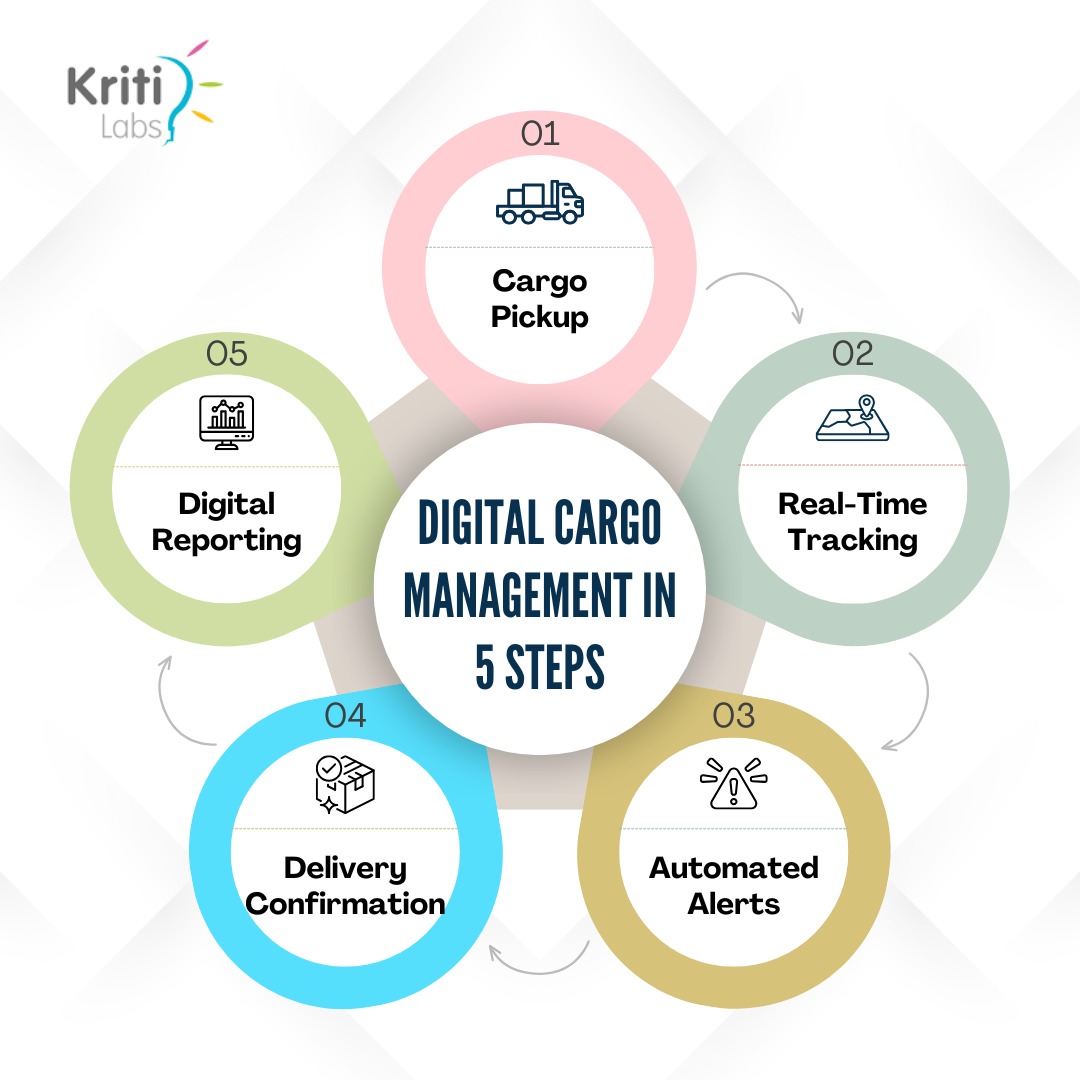
One of the biggest advantages of digital cargo management is real-time visibility . Transportation companies can track cargo movement across routes, checkpoints, and delivery locations.
With live tracking, dispatch teams can quickly answer questions such as:
- Where is the shipment right now?
- Is the vehicle following the planned route?
- Has there been an unexpected stoppage?
- Is the cargo likely to arrive on time?
This level of visibility reduces uncertainty and helps teams respond quickly to operational disruptions. If there is traffic, a breakdown, or a route deviation, the control team can take corrective action before the issue affects delivery commitments.
Improved Operational Efficiency
Manual coordination consumes time and increases the chances of errors. Teams may need to repeatedly call drivers, update spreadsheets, check documents, and manually inform customers of shipment status.
Digital cargo management reduces this dependency by automating routine updates. Shipment status, route history, delivery timelines, and exceptions can be viewed through a central dashboard.
This improves efficiency in several ways:
- Faster decision-making
- Reduced paperwork
- Better coordination between dispatch teams and drivers
- Less time spent on manual follow-ups
- Easier tracking of multiple shipments at once
For transportation companies managing many vehicles and routes, this can significantly reduce administrative workload.
Enhanced Cargo Security and Risk Reduction
Cargo security is a major concern in transportation, especially when shipments involve high-value goods, sensitive materials, or time-critical deliveries. Manual monitoring often fails to detect risks early.
Digital cargo management improves security through real-time alerts and data-based monitoring. Systems can notify teams about:
- Route deviations
- Unauthorised stops
- Unusual delays
- Tampering attempts
- Unexpected door openings
- Entry into high-risk zones
This enables faster intervention and reduces the chances of theft, pilferage, or loss. For industries such as banking, logistics, retail, pharmaceuticals, manufacturing, and oil and gas, secure cargo movement is essential.
Accurate Documentation and Compliance
Transportation operations often require detailed documentation. Shipment logs, route records, loading data, delivery proof, inspection records, and compliance documents must be maintained accurately.
Manual documentation is prone to delays and mistakes. Missing or inaccurate records can create problems during audits, insurance claims, or customer disputes.
Digital cargo management creates automatic records of important shipment events. These may include:
- Pickup time
- Route history
- Vehicle stoppages
- Delivery confirmation
- Access or tamper alerts
- Proof of delivery
This creates a reliable audit trail and helps transportation companies meet internal and external compliance requirements.
Better Route Planning and Optimisation
Route planning directly affects cost, delivery time, fuel consumption, and customer satisfaction. Poor route planning can lead to delays, longer travel distances, higher fuel usage, and increased driver fatigue.
Digital cargo management systems help transportation companies analyse route performance and identify better alternatives. By using GPS data, traffic patterns, and historical trip information, teams can select safer and more efficient routes.
This supports:
- Lower fuel consumption
- Reduced transit time
- Fewer delays
- Better driver utilisation
- Improved delivery predictability
Route optimisation is especially useful for logistics companies operating across multiple cities, warehouses, or delivery hubs.
Improved Customer Experience
Customers increasingly expect transparency in logistics. They want timely updates, accurate delivery estimates, and quick responses when problems occur.
Digital cargo management improves customer experience by making shipment information more reliable. Instead of vague updates, companies can provide real-time status, expected arrival time, and proof of delivery.
This reduces disputes and improves trust. When customers know where their shipment is and when it will arrive, they are more likely to see the transportation company as dependable and professional.
Cost Reduction and Resource Optimisation
Digital cargo management also supports cost savings. By improving visibility and control, transportation companies can reduce avoidable expenses associated with fuel waste, vehicle misuse, delays, and inefficient routing.
Cost benefits may come from:
- Reduced fuel consumption
- Lower detention and delay costs
- Better vehicle utilisation
- Reduced cargo loss or theft
- Lower administrative effort
- Faster dispute resolution
Over time, these savings can contribute significantly to profitability.
Data-Driven Decision Making
Transportation companies generate a large amount of operational data every day. However, without digital systems, much of this information remains scattered or unused.
Digital cargo management brings this data into one place. Teams can analyse trends such as recurring delays, inefficient routes, high-risk zones, driver performance, and customer service gaps.
These insights help organisations make better decisions. Instead of relying only on assumptions, managers can use data to improve planning, allocate resources, and strengthen operational discipline.
Key Features of a Digital Cargo Management System
A strong digital cargo management system should offer a practical combination of visibility, control, and reporting. Important features may include:
- Real-time GPS tracking
- Centralised dashboard access
- Automated alerts and notifications
- Route deviation monitoring
- Digital proof of delivery
- Cargo condition monitoring
- Analytics and reporting tools
- Integration with vehicle tracking or driver management systems
Industry Use Cases of Digital Cargo Management
Logistics and Freight Companies
Freight companies can track cargo movement from pickup to final delivery. Real-time alerts help reduce delays, improve coordination, and strengthen customer communication.
Manufacturing and Distribution
Manufacturers can monitor raw material movement, finished goods delivery, and supplier dispatches. This helps maintain production timelines and reduces supply chain uncertainty.
E-commerce and Retail
Retail and e-commerce businesses depend on fast and accurate delivery. Digital cargo management helps improve last-mile visibility, delivery scheduling, and customer updates.
Cold Chain and Sensitive Cargo
For temperature-sensitive goods such as food, pharmaceuticals, or chemicals, digital cargo systems can track conditions during transit. Alerts can be triggered if temperature or handling conditions move outside acceptable limits.
High-Value Cargo
Banking logistics, jewellery movement, electronics, and industrial components require stronger security. Digital tracking, tamper alerts, and route monitoring reduce the risk of theft or mishandling.
Digital Cargo Management vs Traditional Methods
| Aspect | Traditional Cargo Management | Digital Cargo Management |
|---|---|---|
| Shipment Visibility | Limited and delayed | Real-time tracking and updates |
| Documentation | Paper-based and manual | Digital records and automated logs |
| Risk Detection | Mostly reactive | Alerts for deviations, delays, and tampering |
| Customer Updates | Manual and often delayed | Faster and more accurate communication |
| Reporting | Time-consuming | Dashboard-based reports and analytics |
| Scalability | Difficult as volume grows | Easier to scale across routes and locations |
Role of AI and IoT in Digital Cargo Management
AI and IoT are central to the future of cargo management. IoT devices help capture real-time information from vehicles, cargo units, locks, seals, and sensors. AI helps analyse this information and identify patterns that need attention.
Together, they support:
- Predictive alerts
- Risk detection
- Route intelligence
- Cargo condition monitoring
- Automated exception management
- Better operational planning
For example, if a vehicle stops at an unauthorised location or a cargo seal shows signs of tampering, the system can immediately notify the control team. This reduces response time and improves cargo protection.
Challenges in Implementing Digital Cargo Management
While digital cargo management offers clear benefits, its implementation must be carefully planned. Common challenges include:
- Initial investment in devices and software
- Integration with existing transport systems
- Training teams and drivers
- Managing large volumes of data
- Ensuring data security and access control
These challenges can be managed through phased implementation. Companies can begin with high-value routes or critical cargo categories, then expand gradually across operations.
Training is also important. Drivers, dispatch teams, and managers should understand how the system works and how to handle alerts.
Future of Digital Cargo Management
The future of transportation will be increasingly connected. Digital cargo management systems will continue to evolve with AI-driven predictions, deeper integration with vehicle systems, and greater automation.
Future developments may include:
- Predictive delivery delay alerts
- Automated route risk scoring
- Smart cargo condition tracking
- Integration with warehouse and delivery centre systems
- Better visibility across multi-modal logistics
As transportation networks become more complex, digital systems will play a larger role in ensuring cargo safety, efficiency, and reliability.
Conclusion
Digital cargo management is becoming essential for transportation companies that want better visibility, lower risk, and stronger operational control. It improves shipment tracking, cargo security, documentation, route planning, customer communication, and decision-making.
For transportation companies managing growing shipment volumes, digital cargo management is not just a technology upgrade. It is a practical step towards safer, more efficient, and more transparent logistics operations.
By combining GPS, IoT, cloud platforms, and real-time alerts, organisations can build transportation systems that are more reliable, more accountable, and better prepared for the future.
Frequently Asked Questions
1. What is digital cargo management?
Digital cargo management is the use of digital tools, such as GPS tracking, IoT sensors, cloud-based dashboards, and automated alerts, to monitor and manage cargo movement. It helps transportation companies track shipments, reduce manual work, and improve operational visibility.
2. How does digital cargo management improve cargo security?
Digital cargo management improves cargo security by providing real-time tracking, alerts for route deviations, tamper notifications, and access records. This helps teams respond quickly to theft risks, unauthorised stops, or suspicious movement during transit.
3. Why do transportation companies need digital cargo management?
Transportation companies need digital cargo management to reduce delays, improve shipment visibility, lower operational costs, and maintain accurate documentation. It also helps improve customer communication and supports better compliance.
4. Can digital cargo management reduce logistics costs?
Yes. It can reduce costs by improving route planning, lowering fuel wastage, reducing cargo loss, minimising manual coordination, and improving vehicle utilisation. Over time, these savings can improve overall profitability.
5. How does IoT support digital cargo management?
IoT supports digital cargo management by collecting real-time data from vehicles, cargo units, locks, seals, and sensors. This data helps monitor cargo condition, detect tampering, track movement, and trigger alerts when action is needed.