
.jpeg)
How AI Monitoring Systems Improve Operational Visibility and Prevent Downtime
For many organisations, downtime is more than an equipment problem. A failed machine can interrupt production, a malfunctioning facility system can affect employees and customers, and an undetected infrastructure issue can disrupt operations across an entire site. When these problems are not identified early, the resulting costs can include repairs, lost productivity, delayed services and inefficient use of resources.
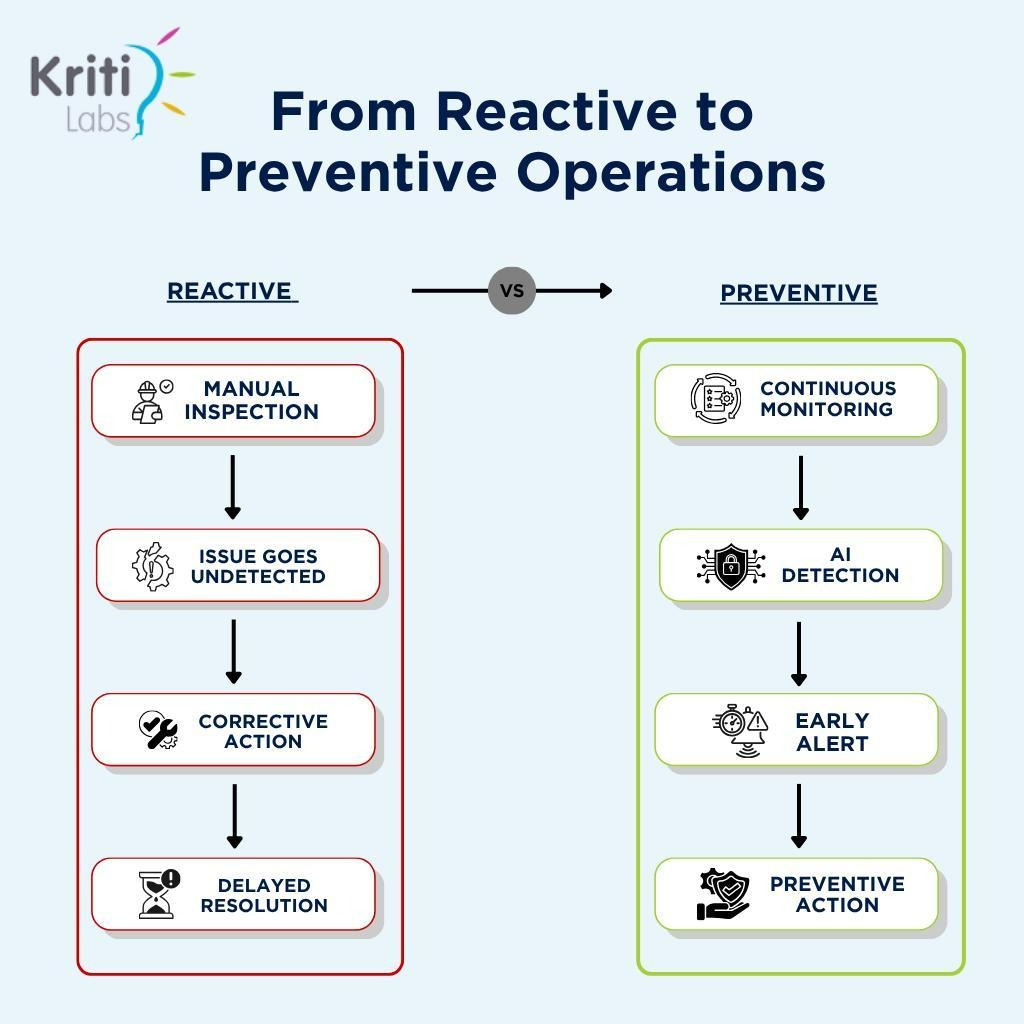
Traditional monitoring methods often rely on periodic inspections, manual checks, and teams responding only after a problem becomes visible. That approach can leave a significant gap between the first sign of an issue and the moment someone acts on it.
AI monitoring systems are changing this approach. By combining IoT data, AI-based analysis, real-time alerts and operational workflows, organisations can continuously monitor assets and activities, identify unusual conditions and act earlier. The value is not simply in collecting more data. It is in turning that data into timely information that supports preventive action.
For enterprises managing complex facilities, distributed assets or critical infrastructure, this shift from reactive monitoring to real-time intelligence can play an important role in reducing avoidable downtime.
What Are AI Monitoring Systems?
AI monitoring systems use artificial intelligence to analyse information collected from connected devices, sensors, cameras and other operational systems. Instead of relying entirely on people to watch, inspect or interpret every data point, the system can identify patterns and highlight situations that require attention.
An AI monitoring environment may receive data from:
- IoT sensors
- Equipment and asset monitoring devices
- CCTV and video analytics systems
- Environmental sensors
- Access and operational systems
AI then analyses this information to detect anomalies, identify changes from expected behaviour and provide relevant alerts.
The distinction between conventional monitoring and AI-based monitoring is important. A conventional system may show that a machine is running or that a sensor has crossed a threshold. An AI monitoring system can analyse patterns across different data points and help identify whether those changes indicate a developing operational issue.
Why Traditional Monitoring Can Lead to Costly Downtime
Manual monitoring remains useful in many environments, but it can become difficult to scale as the number of assets, facilities and operational processes increases.
One challenge is delayed issue detection. Equipment may be inspected only at set intervals, meaning a developing problem can go unnoticed between checks.
Another is fragmented information. When maintenance records, sensor data, security systems and facility information sit in separate applications, teams may lack the complete context needed to understand an issue.
There is also the question of manual escalation. A team member may notice a problem, report it to another person, wait for it to be assigned and then wait again for the response. Every handoff can add time.
Finally, historical data may not be used effectively. If recurring equipment or facility problems are recorded but not analysed collectively, organisations can miss patterns that point to more serious underlying issues.
These gaps can turn a small operational exception into a larger disruption.
How AI Monitoring Helps Prevent Downtime
The central value of AI monitoring lies in connecting continuous observation with timely action.
Continuous Monitoring of Assets and Operations
IoT devices provide a continuous stream of information from physical assets and operating environments. Depending on the application, this may include temperature, vibration, equipment status, energy usage, occupancy or other operational parameters.
Instead of waiting for a scheduled inspection, teams can have a live view of important conditions. This is particularly valuable for assets where an unexpected failure could affect production, safety or service delivery.
KritiLabs' approach to AI²oT combines AI, IoT and automation to analyse data from connected devices and support real-time insights and operational management.
Detecting Anomalies Earlier
AI can establish patterns in operational data and identify deviations from expected behaviour. This is important because potential failures do not always appear as a single obvious event.
For example, a gradual change in equipment temperature combined with unusual vibration may indicate a developing issue. Similarly, repeated operational exceptions in a facility can reveal a recurring problem that deserves investigation.
By highlighting these deviations early, AI monitoring gives maintenance and operations teams more time to assess the situation.
Real-Time Alerts and Escalation
Identifying an issue is only useful when the right team knows about it.
AI monitoring systems can generate alerts when predefined conditions or unusual patterns are detected. These alerts can then be routed to the relevant operational team, rather than relying entirely on someone to manually notice the problem.
A well-designed system should therefore connect detection with workflow. An alert may lead to a service request, task assignment, inspection or maintenance action, depending on the severity of the issue.
From Detection to Maintenance Action
This is where AI monitoring becomes more than a surveillance tool.
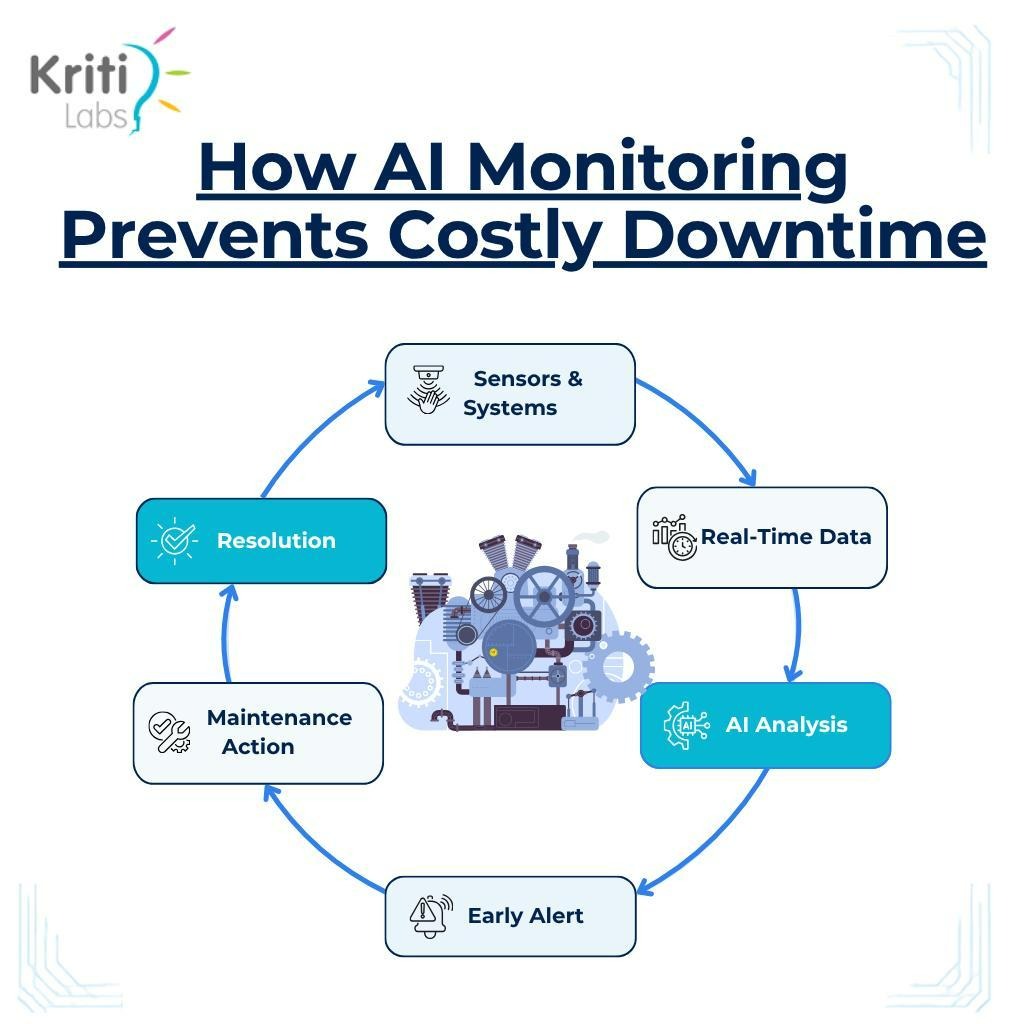
Consider a connected facility in which an asset begins to show abnormal readings. The system identifies the change, generates an alert, creates or updates a service request, assigns the issue to the appropriate team and tracks its resolution.
KritiLabs' Realtime Enterprise Management Platform includes capabilities for service requests, incidents and maintenance workflows, allowing organisations to manage operational issues through a central platform.
The Role of IoT in AI Monitoring Systems
AI is only as useful as the information available to it. IoT provides the data collection layer that allows AI monitoring systems to understand what is happening in the physical environment.
Sensors can continuously capture information from machinery, buildings, vehicles and other assets. This data can then be transmitted to a central platform for processing and analysis.
KritiLabs positions its AI²oT approach around the combination of artificial intelligence, IoT, and automation, with applications that include monitoring assets and analysing IoT sensor data to generate real-time insights.
The result is a continuous cycle:
Collect → Analyse → Detect → Alert → Act → Learn
The more effectively these stages are connected, the easier it becomes for organisations to move towards preventive operations.
Centralised Visibility Across Enterprise Operations
Downtime prevention becomes more difficult when operational information is spread across different departments and locations.
A manufacturing plant may have maintenance information in one system, security events in another and asset data in a third. A company with multiple facilities may also have limited visibility into what is happening at each location.
A centralised platform can bring these different data sources into a common operating environment. Managers can monitor assets, facilities, operational activities and alerts through a unified dashboard rather than relying on multiple disconnected systems.
KritiLabs' REMP is designed to provide centralised visibility into assets, facilities, and operational activities, including system status, alerts, and performance metrics across multiple locations.
This wider view also improves coordination. A maintenance issue, for example, can be considered alongside an incident report or other operational information rather than handled in isolation.
How Real-Time Intelligence Applies Across Industries
AI monitoring is not limited to a single operational environment.
Manufacturing
Manufacturing organisations depend on equipment availability and consistent production. Monitoring asset behaviour can help teams identify developing issues earlier and schedule maintenance before a failure causes greater disruption.
Warehouses and logistics facilities contain moving assets, security systems, storage infrastructure and multiple operational processes. Real-time monitoring can help identify equipment issues, operational exceptions and facility problems before they interfere with workflows.
Oil & Gas, Mining and Chemicals
These industries often involve distributed assets and demanding operating environments. Continuous monitoring can support visibility into asset status, safety-related conditions and maintenance requirements.
Banking and Financial Operations
Banks and other financial institutions may use real-time monitoring across facilities, security infrastructure and operational systems. Early alerts can help teams respond to incidents and maintain continuity across multiple locations.
KritiLabs identifies manufacturing, logistics and e-commerce, oil and gas, mining, chemicals, banking and NBFCs, government, utilities and other sectors among the environments where its technology can be applied.
Beyond Downtime: Other Benefits of AI Monitoring
Reducing downtime is one important outcome, but real-time intelligence can support several other aspects of enterprise operations.
Improved operational visibility: Teams can see current conditions rather than relying only on periodic reports.
Faster incident response: Alerts can reach the right people sooner, helping reduce delays.
Better maintenance planning: Historical and real-time information can reveal recurring issues and support more informed maintenance schedules.
Reduced manual monitoring: Employees can focus on exceptions and decisions rather than watching every data source continuously.
Better asset utilisation: Organisations can use operational information to understand how assets are performing and where resources may be underused.
Improved decision-making: Reports and analytics help management identify trends and operational inefficiencies.
These capabilities align closely with REMP, which includes centralised monitoring, service request and incident management, as well as reporting and analytics.
What Should Businesses Look for in an AI Monitoring System?
Selecting an AI monitoring system should involve more than evaluating how many sensors or dashboards a platform supports.
Businesses should consider whether the system provides:
- Real-time data collection
- AI-based anomaly detection
- Configurable alerts
- Centralised operational visibility
- Service request and maintenance workflows
- Reporting and analytics
- Integration with existing infrastructure
- Support for multiple facilities and locations
- Scalability as operational requirements grow
Most importantly, businesses should consider what happens after an issue is detected. A system that identifies a problem but leaves teams to manage the rest manually may not deliver the same value as one that connects detection, communication and resolution.
Implementing AI Monitoring Without Disrupting Operations
Implementation should begin with the areas where downtime carries the greatest operational or financial impact.
Organisations can start by identifying critical assets, recurring failures or processes with slow response times. These areas can then be connected to appropriate sensors, systems and workflows.
Integration is equally important. Existing infrastructure does not necessarily need to be discarded. A platform that can work with current systems can make adoption more practical and reduce disruption.
Finally, organisations should define clear responsibilities. Teams need to know who receives alerts, who validates incidents and who is responsible for resolving them.
KritiLabs’ REMP is designed to integrate IoT devices, enterprise systems and operational workflows into a single platform, supporting real-time monitoring and automated workflows.
The Future of AI Monitoring and Predictive Operations
AI monitoring is moving towards a more predictive model of operations.
Instead of simply displaying a status, systems will increasingly use historical and real-time information to identify patterns that may indicate future problems. This creates a progression from:
Monitoring → Detection → Prediction → Preventive Action
AI and IoT research at KritiLabs includes predictive maintenance, vision-based behaviour analysis and anomaly detection, showing how the technology can extend beyond basic monitoring towards more proactive operational management.
Conclusion: Moving From Reactive Monitoring to Preventive Operations
Downtime becomes increasingly expensive when organisations discover problems only after they have already affected operations.
AI monitoring systems provide a way to narrow this gap. IoT devices collect information continuously; AI analyses that data for unusual patterns; real-time alerts draw attention to important events; and connected workflows help teams take action.
For enterprises managing complex assets, facilities and operations, the real benefit is not simply increased monitoring. It is the ability to connect data, intelligence and action within the same operational environment.
A platform such as KritiLabs' REMP takes this approach further by bringing assets, infrastructure, people and operational workflows together, giving organisations greater visibility and a more structured way to respond to issues.
The shift from reactive monitoring to preventive operations is therefore less about replacing existing systems and more about connecting them intelligently so that small problems can be addressed before they become costly disruptions.