
.jpeg)
Real-Time Enterprise Management Platform for Eliminating Operational Silos
Modern enterprises rarely operate from a single location or through a single team. A typical organisation may have multiple facilities, departments, assets, security systems, maintenance teams and operational processes working simultaneously. While each function may have its own tools and systems, the challenge begins when these systems operate independently.
A security team may have information that the facilities team does not see. Maintenance requests may be handled via email or phone, while asset information is stored in another system. Management may receive reports only after an operational issue has already occurred.
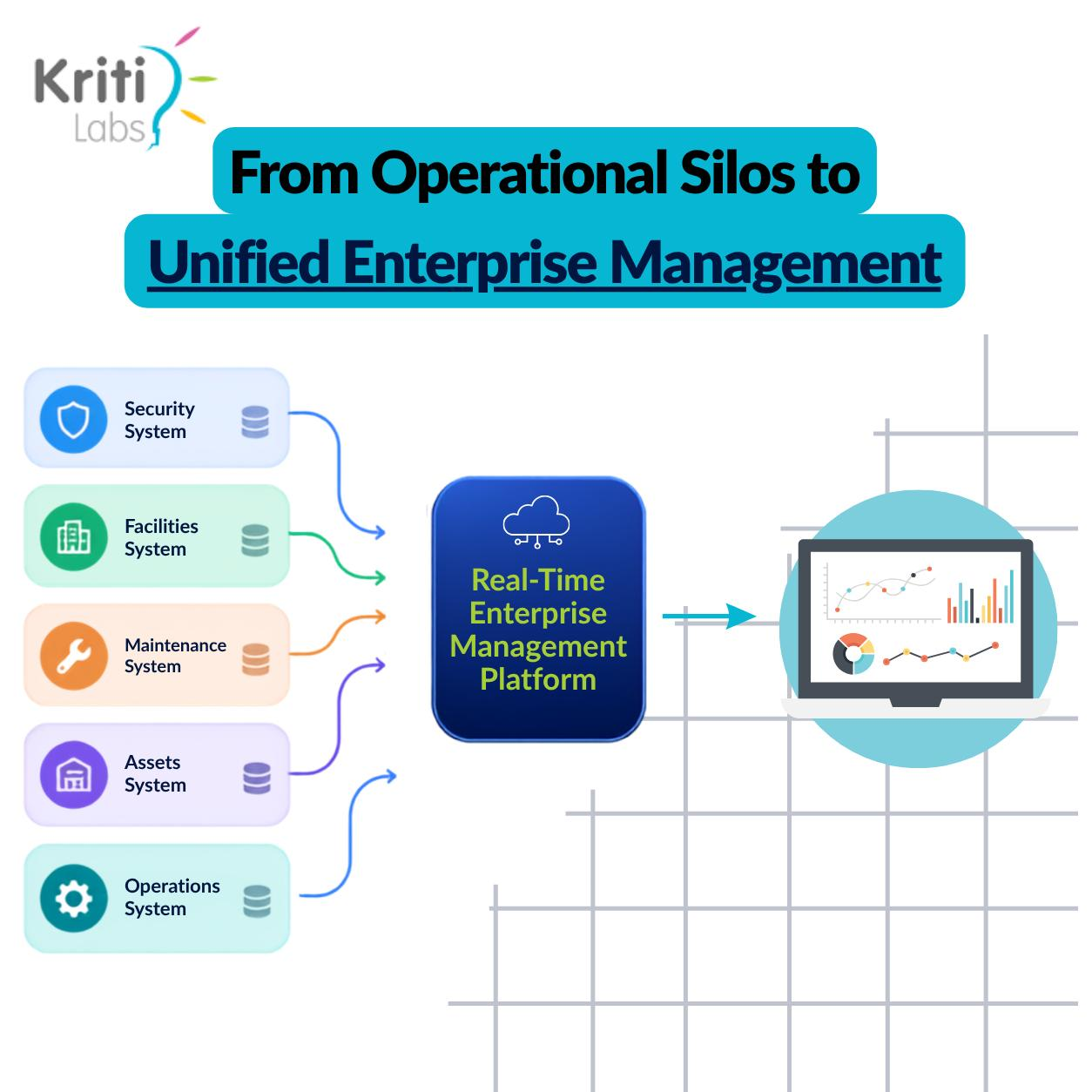
This is where a real-time enterprise management platform can make a difference. By connecting people, assets, infrastructure and operations through a unified platform, businesses can gain better visibility, coordinate responses more effectively and make decisions using current operational information. KritiLabs' Realtime Enterprise Management Platform (REMP) is designed around this approach, combining IoT devices, enterprise systems and operational workflows within a centralised platform.
What Are Operational Silos in an Enterprise?
Operational silos occur when departments, systems, or teams work independently without sufficient information exchange.
For example, consider a large corporate facility. Security may monitor access and surveillance, facilities teams may manage equipment and maintenance, while administration may handle service requests. If these functions operate through separate systems, a problem identified by one team may take time to reach the other team.
The result is often:
- Information being stored across multiple systems
- Different teams having different views of the same situation
- Manual communication between departments
- Delays in assigning and resolving incidents
- Difficulty tracking operational performance
- Limited visibility for management
The issue is not necessarily that organisations lack technology. In many cases, they have plenty of it. The problem is that the systems do not work together.
A real-time enterprise management platform addresses this gap by bringing operational information, workflows and teams into a common environment.
Why Disconnected Systems Create Operational Challenges
As organisations grow, adding separate software for individual functions can seem practical. Over time, however, this can create a complex technology environment in which important information is spread across multiple platforms.
Limited operational visibility
Management teams may need to check several systems to understand what is happening across facilities, assets and operations. This makes it difficult to get a complete picture of performance at any given moment.
Manual coordination
When an incident occurs, employees may need to call, email or message the relevant team before action can begin. Every additional handoff introduces the possibility of delay.
Scattered operational data
Information stored across spreadsheets, standalone applications and disconnected systems is difficult to analyse collectively. Even when the data exists, extracting useful insights can require significant manual effort.
KritiLabs identifies these challenges as key issues for enterprise operations, including limited visibility, manual coordination that slows incident resolution and data distributed across multiple platforms and spreadsheets.
The impact can extend beyond individual incidents. Repeated delays, poor resource allocation and limited visibility into recurring problems can gradually affect operational efficiency.
How a Real-Time Enterprise Management Platform Connects Operations
A real-time enterprise management platform provides a common operational layer that connects people, assets, infrastructure, systems, and workflows.
Instead of treating every function as a separate environment, the platform brings relevant information together so teams can monitor events, manage requests and act on operational data.
For instance, an issue identified within a facility can move through a structured workflow:
Detection → Alert → Assignment → Action → Resolution → Reporting
This is important because visibility alone does not solve an operational problem. The information needs to reach the right people and be connected to an appropriate action.
KritiLabs' REMP integrates IoT devices, enterprise systems and operational workflows into a single intelligent dashboard. Its stated capabilities include real-time monitoring, automated workflows and data-driven decision-making.
The platform is also designed for organisations operating across multiple facilities, teams and assets, making a unified view particularly relevant to complex enterprise environments.
Key Capabilities of a Real-Time Enterprise Management Platform
The value of a real-time enterprise management platform comes from how different operational capabilities work together.
Centralised operations dashboard
A central dashboard provides teams with a common view of assets, facilities and operational activities. Instead of switching between several systems, users can access information such as system status, alerts, and performance metrics through a single interface.
This becomes particularly valuable for organisations managing multiple locations, where getting a consistent operational view can otherwise be difficult. REMP is designed to provide this visibility across multiple locations.
Complaint and service request management
Operational issues often begin as simple complaints or service requests. The challenge is ensuring that these requests reach the appropriate team and remain visible until they are resolved.
A structured management workflow can allow organisations to:
- Record incidents and service requests
- Assign tasks to appropriate teams
- Schedule activities
- Track resolution progress
- Monitor outstanding issues
- Maintain a record of completed actions
This creates greater accountability while reducing reliance on informal communication.
Reports and analytics
Real-time information becomes more useful when it can also be analysed over time.
Reporting and analytics can help organisations identify performance trends, recurring problems and operational inefficiencies. Instead of simply knowing that an incident occurred, teams can examine how frequently similar incidents occur, where they happen and how quickly they are resolved.
KritiLabs' REMP includes reporting and analytics capabilities intended to support performance monitoring, identification of inefficiencies and operational planning.
AI-assisted insights
As enterprise platforms collect information from multiple operational sources, AI can help teams interpret that information more effectively.
An AI assistant can support the identification of patterns and provide actionable insights from available operational data. This can help managers move from simply viewing information to understanding what may require attention.
REMP specifically includes an AI Assistant for generating actionable insights.
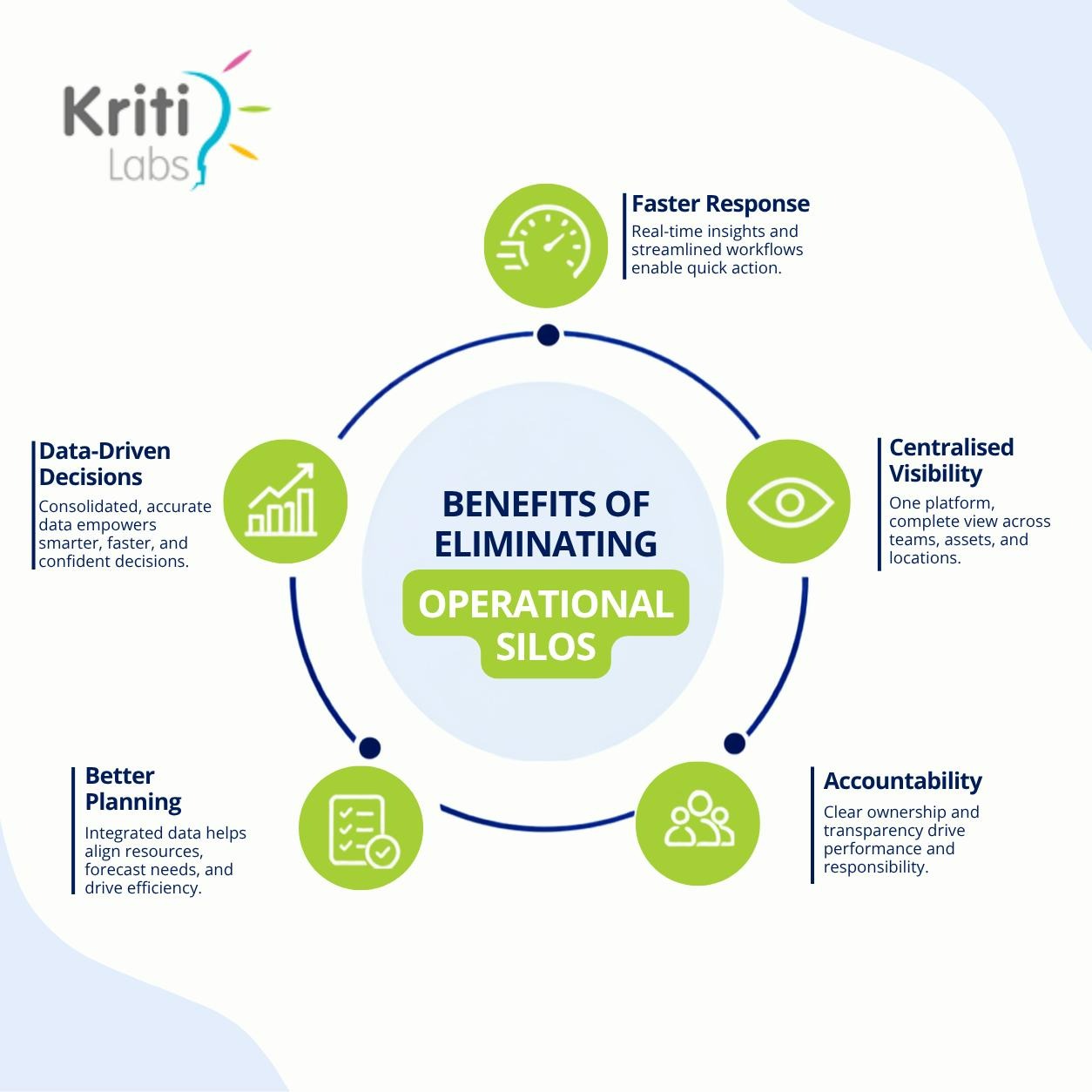
Benefits of Eliminating Operational Silos
Moving from disconnected systems to unified enterprise management can provide several practical benefits.
Faster response to operational issues
When incidents and service requests are automatically routed to the relevant teams, organisations can reduce the delays associated with manual coordination.
Better visibility across locations
A centralised platform can provide management with a common view of operations across multiple facilities. This is particularly useful for enterprises with geographically distributed assets and teams.
Improved accountability
When service requests and incidents are recorded, assigned and tracked through a defined workflow, it becomes easier to establish ownership and monitor progress.
Better operational planning
Historical reports and analytics can reveal recurring issues, performance patterns and areas where resources may be used inefficiently.
More informed decision-making
Access to real-time operational information means managers do not have to rely solely on delayed reports or manually consolidated data. REMP is designed to support faster, data-driven decisions through real-time data, reports and analytics.
Where Can Real-Time Enterprise Management Be Applied?
A real-time enterprise management platform can be useful wherever organisations have multiple assets, teams, facilities or operational processes that need to work together.
Potential deployment environments include:
- Corporate campuses and office complexes
- Manufacturing facilities
- Logistics hubs and warehouses
- Smart city and infrastructure projects
- Government and public sector operations
The same approach can also support industries with complex operational requirements, including logistics and e-commerce, banking and NBFCs, oil and gas, mining, chemicals, government, utilities, manufacturing and FMCG. These are among the environments identified for REMP by KritiLabs.
For example, a manufacturing organisation may need visibility into facilities, equipment and maintenance activities, while a logistics organisation may need to coordinate fleets, assets and operational events. The specific workflows differ, but the underlying requirement is similar: bringing operational information together and making it actionable.
What to Look for in a Real-Time Enterprise Management Platform
Choosing a platform should involve more than comparing dashboards or individual features. Organisations should consider how well the platform fits their existing operational environment.
Integration with existing systems
The platform should be able to work with existing infrastructure, IoT devices and enterprise systems rather than requiring organisations to replace everything.
Centralised visibility
Users should be able to access meaningful operational information through a unified interface, particularly when managing multiple locations.
Workflow management
The platform should connect events with actions, allowing organisations to assign, schedule and track service requests and incidents.
Reporting and analytics
Operational data should be available for both immediate monitoring and longer-term analysis.
Scalability
As organisations add facilities, assets, departments or workflows, the platform should be capable of supporting that growth.
Ease of adoption
Enterprise technology should complement existing processes rather than create unnecessary disruption. REMP states that it is designed to integrate with existing infrastructure and support adoption without disrupting workflows.
Moving From Siloed Operations to Real-Time Enterprise Management
Operational complexity is unlikely to decrease as businesses expand across locations, assets and teams. Adding another standalone application may solve one problem while creating another disconnected data source.
A better approach is to create a connected operational environment in which people, assets, infrastructure, and workflows can be managed together.
A real-time enterprise management platform provides the foundation for this approach. By combining centralised monitoring, service request management, analytics and AI-assisted insights, organisations can improve operational visibility and create more structured responses to day-to-day challenges.
KritiLabs' REMP is built around this model, providing a unified platform for organisations managing single or multiple enterprise locations.
For businesses looking to reduce operational silos and gain greater control over complex operations, the next step is to assess where information is currently fragmented, which workflows depend on manual coordination and how a unified platform could connect them.