
.jpeg)
Why Video Analytics Is Becoming Part of Modern Facility Management
Video surveillance has long been a standard part of facility management. Cameras are installed across entrances, parking areas, production floors, warehouses, corridors and other critical zones to improve security and maintain visibility.
But traditional CCTV has one major limitation: it records events, while people still have to interpret them.
For modern facilities, that approach is increasingly difficult to scale. A large site can have hundreds of cameras generating continuous video feeds. Expecting security personnel or facility managers to watch every feed continuously is neither practical nor reliable.
This is where video analytics changes the role of surveillance. Using AI and computer vision, video feeds can be analysed in real time to identify people, vehicles, objects, movement patterns and specific events. Instead of simply storing footage for later review, the system can identify relevant activity in real time and generate alerts or insights.
For facility managers, this can support everything from security and crowd management to process compliance and operational efficiency.
Here are ten practical video analytics use cases in facility management.
1. Intrusion and Restricted-Zone Monitoring
One of the most important applications of video analytics is the identification of unauthorised movement.
Facilities often contain areas that should only be accessed by specific employees, contractors or authorised personnel. These can include server rooms, storage areas, production zones, control rooms, loading areas and other restricted sections.
AI-powered video analytics can establish virtual boundaries around these areas and identify when someone enters or crosses them without authorisation.
Instead of requiring an operator to constantly monitor the camera feed, the system can generate an alert when a predefined event occurs. Security teams can then investigate and respond much faster.
This is particularly useful for large facilities, where monitoring every access point manually is difficult.
2. Occupancy and Crowd Monitoring
Managing the number and movement of people within a facility is another important application.
Video analytics can count people entering and leaving a particular area, estimate occupancy levels and identify crowd build-up. This can be useful in corporate campuses, transport facilities, warehouses, manufacturing plants, public infrastructure and other high-footfall environments.
For example, if a particular entrance begins to experience unusually high congestion, facility teams can take action by opening another access point or redirecting traffic.
Occupancy information can also contribute to better space utilisation. Instead of relying on assumptions about how spaces are being used, managers can use actual data to understand movement patterns and capacity requirements.
KritiLabs has also applied AI-powered video analytics to crowd management environments, where real-time information about crowd density and movement can help teams respond before congestion becomes a larger operational or safety issue.
3. Safety Compliance Monitoring
Maintaining workplace safety often depends on employees and contractors following established procedures.
In a large facility, manually checking compliance across every area is challenging. Video analytics can help by identifying specific visual conditions that indicate a potential safety violation.
For example, systems can be configured to monitor whether workers are entering designated zones, whether required safety equipment is being used, or whether certain activities are taking place in prohibited areas.
The objective is not to replace safety teams. Instead, video analytics provides them with an additional layer of continuous monitoring and helps direct attention towards situations that require investigation.
This can make safety monitoring more consistent, particularly across facilities operating multiple shifts.
4. Perimeter Security and Unusual Movement Detection
Facility perimeters are another area where continuous monitoring can be difficult.
Large industrial sites, warehouses, logistics facilities and infrastructure projects may have extensive boundaries with multiple access points. Security personnel may not always be able to observe every section with the same level of attention.
Video analytics can analyse movement around defined perimeter zones and identify events such as a person entering an unauthorised area or unusual movement during restricted hours.
The resulting alerts can be routed to the relevant security personnel for verification and response.
This approach shifts perimeter monitoring from simply recording footage to actively identifying events that deserve attention.
5. Vehicle and Traffic Monitoring
Facilities often have significant vehicle movement involving employees, visitors, delivery vehicles, forklifts, trucks and other commercial vehicles.
Video analytics can help monitor vehicle movement within these environments. Depending on the application, systems can identify vehicles, monitor movement patterns and support access or traffic management.
For example, analytics can help identify vehicles entering restricted areas, detect unusual stopping behaviour or provide information about traffic patterns at facility entrances.
When combined with other systems, this information can give facility managers a more complete picture of how vehicles move through the site.
6. Parking Management
Parking areas are often overlooked when discussing facility operations, despite being an important part of the daily experience for employees, visitors and customers.
Video analytics can help monitor vehicle occupancy, entry and exit activity and parking utilisation.
Facility managers can use this information to understand which areas are underused, where congestion occurs, and when parking demand peaks.
For larger campuses, these insights can support better allocation of parking spaces and improve traffic flow around entry and exit points.
The same camera infrastructure can potentially support security monitoring as well, allowing facilities to derive multiple operational benefits from their existing surveillance systems.
7. Process and Workflow Compliance
Video analytics is not limited to traditional security applications.
In manufacturing, logistics and other operational environments, cameras can also be used to monitor whether processes are being followed correctly.
For example, an AI system can monitor a defined workstation or operational area and determine whether a particular step has been completed or an error has occurred.
This can be particularly valuable in high-volume environments where manual inspection is difficult to maintain consistently.
KritiLabs has demonstrated this approach in logistics operations, where AI video analytics was used to identify errors at Put-to-Light workstations, alert operators in real time and record events for traceability and training.
This shows how video analytics can move beyond security and become part of day-to-day operational management.
8. Asset and Equipment Monitoring
Facilities contain numerous assets that need to remain available, secure and operational.
Video analytics can provide another source of information about how assets and equipment are being used or accessed.
For example, cameras can monitor designated areas where equipment is stored and identify unexpected movement or activity. Analytics can also be used alongside other technologies to provide a broader understanding of asset status and movement.
This becomes particularly useful when video data is combined with asset tracking, maintenance information or other operational systems.
9. Incident Detection and Faster Response
One of the biggest advantages of real-time video analytics is the reduction in the time between detection and response.
With conventional surveillance, an incident may only be discovered when an operator notices it on a live screen or reviews recorded footage after the event.
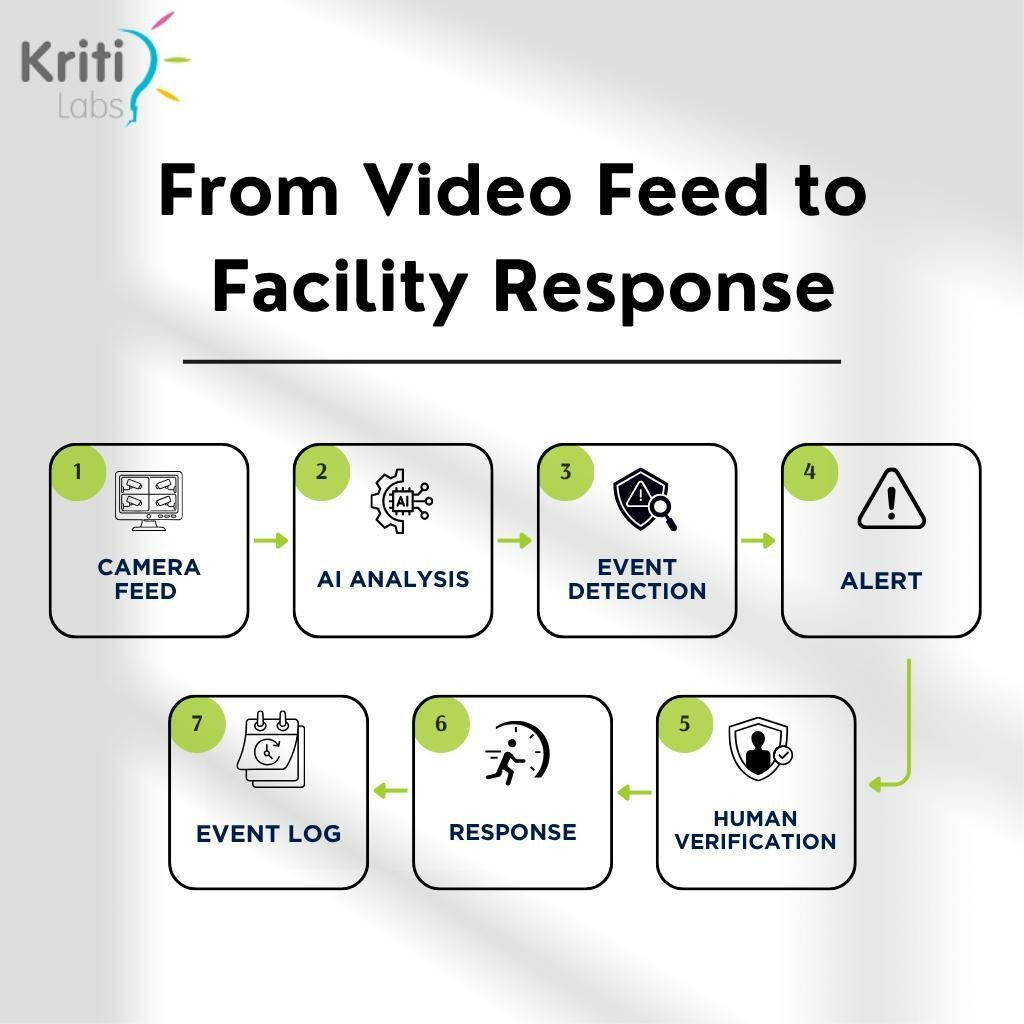
AI-based systems can continuously analyse video feeds and flag predefined events as they occur. These events can then trigger alerts for security or facility teams.
For example, an alert could be generated when an unauthorised person enters a restricted zone, when occupancy crosses a defined threshold or when a specific safety condition is detected.
The value is not simply in generating more alerts. Effective systems need to identify meaningful events and present them in a way that allows teams to prioritise and act.
10. Centralised Facility Monitoring and Reporting
Perhaps the most useful application is bringing video analytics data into a broader facility management environment.
Modern facilities rarely operate through surveillance alone. Security, maintenance, assets, service requests and operational processes all generate information that facility managers need to monitor.
When video analytics is integrated with other operational systems, managers can move towards a more unified view of what is happening across the facility.
For example, a security event detected via video analytics could be linked to an incident record. A service request could then be assigned to the appropriate team, with progress tracked through the same operational environment.
This is where video analytics can become part of a wider real-time facility management strategy rather than functioning as an isolated security system.
KritiLabs' Realtime Enterprise Management Platform (REMP), for example, is designed to bring IoT devices, enterprise systems and operational workflows together through a centralised platform. Its capabilities include centralised dashboards, service request management, reporting and analytics.
Making Video Analytics Part of Modern Facility Management
The most effective use of video analytics is not simply adding AI to an existing CCTV network. The real value comes from connecting visual information with the processes that facility teams already use.
A security alert should lead to an appropriate response. An operational anomaly should reach the relevant team. A recurring issue should be visible in reports and analytics. And important events should leave an audit trail that can be reviewed later.
This is why integration matters.
AI-based video analytics can provide the detection layer, while facility management platforms, IoT devices, access control systems and operational workflows can provide the context and response mechanisms around it.
For organisations managing complex facilities, this creates a shift from passive surveillance towards active operational monitoring.
The result is a facility where cameras do more than record what happened. They can help teams understand what is happening, identify events that require attention and respond with greater speed and consistency.
As facilities grow and operational requirements become more complex, the ability to turn continuous video into usable operational information will become increasingly important.
Conclusion
Video analytics is becoming an important technology for modern facility management because it extends the role of cameras from recording events to generating actionable information.
From intrusion detection and occupancy monitoring to safety compliance, process monitoring and incident response, its applications go well beyond conventional security.
The greatest potential comes when video analytics works alongside IoT, asset management and enterprise workflows. In that environment, visual information becomes part of a larger operational picture, helping facility managers make faster and better-informed decisions.
For organisations looking to improve security, efficiency and operational visibility, the question is no longer simply whether cameras are installed. It is whether the information generated by those cameras can actively support the way the facility is managed.