
Why Cargo Security Needs More Than Traditional Seals
Cargo transportation involves several stages, from loading and dispatch to transit, unloading and final delivery. During this journey, goods may pass through multiple locations and personnel, making it important for businesses to maintain control over access and cargo integrity.
Traditional security seals help indicate whether a container or cargo compartment has been opened. However, physical inspection and manual record-keeping may not provide sufficient visibility throughout the journey.
Smart seals add digital identification and verification to the sealing process. By combining physical security features with technologies such as RFID and QR codes, they help businesses maintain records of cargo verification and improve accountability during transportation.
What Are Tamper-Proof Seals?
Tamper-proof seals are security devices used to protect containers, packages, trucks and storage compartments against unauthorised access. They are designed to make interference difficult or detectable, helping businesses establish whether cargo has remained secured during handling and transportation.
Common types of security seals include:
- Plastic security seals: Lightweight seals commonly used for bags, containers and packages.
- Metal bolt seals: Strong physical seals used for shipping containers and heavy-duty cargo applications.
- Cable seals: Adjustable seals used to secure different types of containers and equipment.
- Electronic seals: Digital security devices that combine physical sealing mechanisms with electronic identification and verification features.
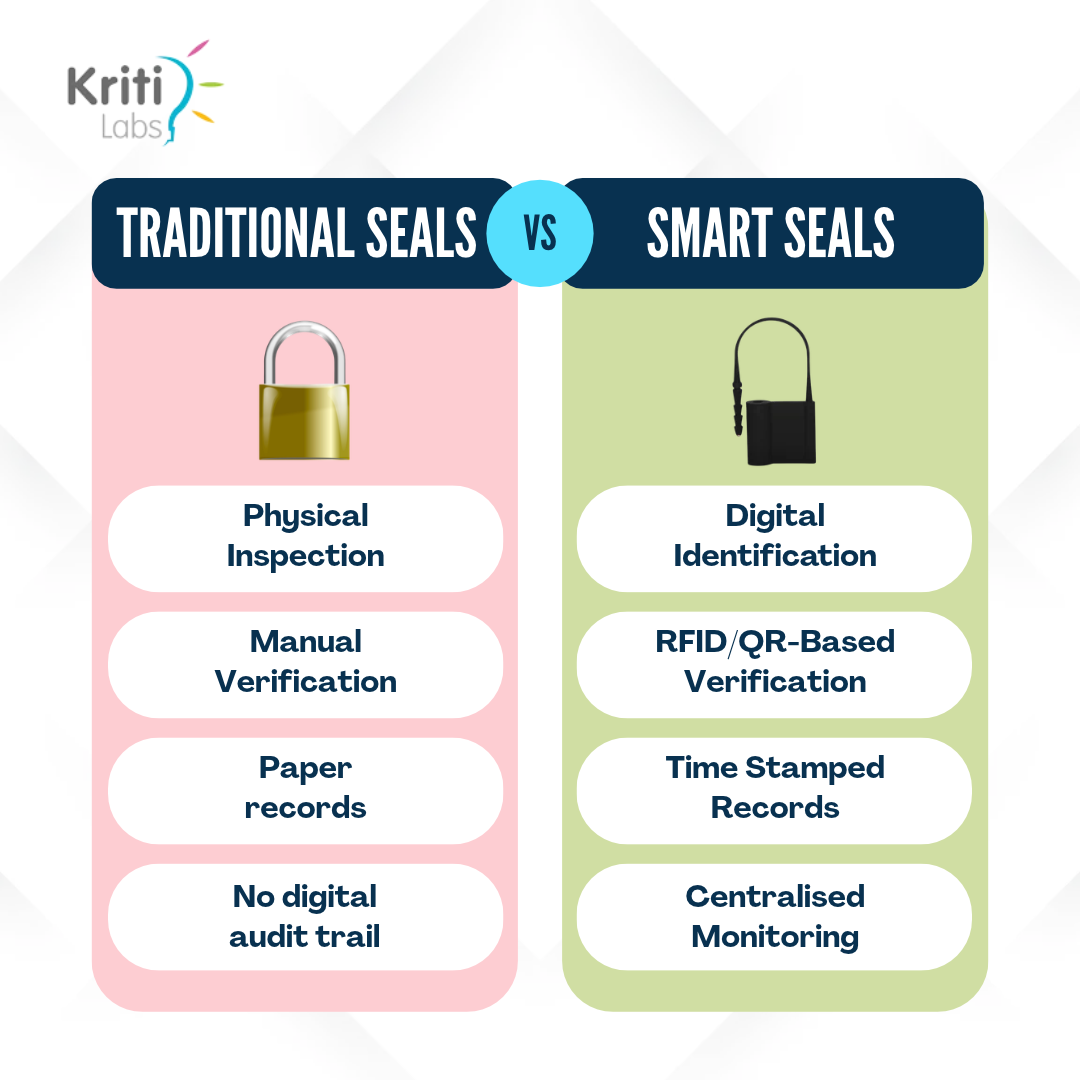
Traditional seals generally rely on physical inspection and manual recording of identification numbers. Electronic or smart seals add a digital layer, allowing businesses to verify seal information and maintain records of security checks.
It is worth distinguishing between tamper-proof and tamper evident. No physical seal can guarantee that interference is impossible. A tamper-evident seal is designed to make unauthorised interference visible or detectable.
Why Traditional Cargo Seals May Not Be Enough
Conventional security seals continue to serve an important purpose, but they have limitations when used across complex transportation operations.
Limited visibility during transit
Once a shipment leaves the dispatch location, businesses may have little information about its security status until the next inspection. A physical seal alone does not provide continuous updates about cargo conditions or verification events.
Dependence on manual verification
Employees often need to inspect seals and compare identification numbers against paperwork or registers. This process can become time-consuming when shipments pass through several checkpoints.
Possibility of seal replacement
Some conventional seals can be removed or replaced. If identification numbers are not checked carefully, discrepancies may go unnoticed.
Incomplete audit records
Paper-based records may not consistently capture who inspected a shipment, when it was checked or where the verification took place.
Delayed identification of discrepancies
If a seal irregularity is discovered only when cargo reaches its destination, identifying when and where the issue occurred can be difficult.
These limitations highlight the need for more structured verification and digital record-keeping throughout cargo transportation.
What Are Smart Seals and How Do They Work?
Smart seals combine a physical sealing mechanism with digital identification or verification technology. Depending on their design, they may use RFID tags or QR codes to establish a digital identity for a sealed shipment.
Although the underlying technologies differ, the basic process follows four stages.
1. Securing the Cargo
The seal is attached to the designated locking point of a container, truck or cargo compartment. This creates a physical barrier against unauthorised opening.
2. Establishing Digital Identification
The smart seal is associated with a unique digital identifier. RFID-based seals use an integrated RFID tag, while QR-based seals carry a unique QR code that can be scanned using a compatible mobile device.
3. Verifying the Seal
During loading, transit or unloading, authorised personnel can scan the seal using a compatible RFID reader or mobile application.
The system can check the seal's identity against the relevant shipment record and capture the verification event.
4. Recording Verification Events
The captured information can be transmitted to a connected platform. Depending on the solution, records may include seal identification, timestamps, user details and GPS coordinates.
This creates a digital record of verification activities, helping businesses review cargo security checks across different stages of transportation.
How Smart Seals Improve Cargo Security
Smart seals offer several practical advantages over security processes that depend entirely on physical inspection.
Digital Seal Verification
Unique identifiers help operators verify whether the seal presented at a checkpoint matches the expected shipment record. This makes it easier to identify discrepancies during loading, transit and unloading.
Better Tamper Evidence
Smart seals combine physical security features with digital identification. Certain designs also incorporate visual tamper-evident features, helping personnel identify possible interference during inspection.
Time-Stamped Audit Trails
Digital verification can create records of when a seal was scanned and, depending on the system, who performed the check and where it took place. These records support audits and help businesses investigate discrepancies.
Improved Visibility Across Transportation
When connected to a central platform, seal verification information can be made available to authorised personnel across different operational locations. Managers can review verification activity without relying entirely on paper records or phone updates.
Greater Accountability
Digital records provide a clearer account of cargo verification activities. This helps businesses establish responsibility at different stages of transportation and identify where additional checks may be required.
However, smart seals should not automatically be considered continuous tracking devices. A scan-based system records verification events at designated checkpoints. Continuous vehicle or cargo tracking requires additional tracking infrastructure.
Where Are Smart Seals Used?
Smart seals are useful in industries where cargo integrity and controlled access are important.
Logistics and Distribution
Logistics companies can use smart seals to verify shipments during dispatch, transit checkpoints and delivery. Digital records help maintain a consistent verification process across multiple locations.
Oil and Gas Transportation
Fuel tankers and other vehicles carrying high-value materials require careful monitoring. Smart sealing solutions can support cargo verification and help maintain records during transportation.
Warehousing and Distribution Centres
Warehouses can use digital seal verification when goods are dispatched or received. This helps employees confirm shipment identification and maintain records of security checks.
Banking and Valuables Transportation
Cash, jewellery and other high-value consignments require controlled handling. Smart seals can support verification processes for secure containers and transportation boxes.
Manufacturing Supply Chains
Manufacturers transporting components, finished products and valuable materials between facilities can use smart seals to improve shipment verification and accountability.
In each case, the objective is to make cargo security checks more structured and easier to review.
RFID Smart Seals vs QR-Based Smart Seals
Smart seals can use different technologies depending on how businesses intend to identify and verify cargo.
Two common approaches are RFID-based and QR-based smart seals.
| RFID SmartSeal | QR-Based SmartSeal |
|---|---|
| Uses an integrated RFID tag | Uses a unique QR code |
| Read using a compatible RFID reader | Scanned using a compatible mobile device |
| RFID tag activates when the seal is locked | Digital verification takes place through QR scanning |
| Suitable for RFID-based identification workflows | Supports mobile-based verification and digital event records |
RFID-based solutions are useful where businesses already have compatible readers or need to incorporate RFID scanning into existing asset management processes.
QR-based solutions offer a different approach. They allow authorised personnel to scan a seal using a mobile device, reducing the need to deploy dedicated RFID readers at every verification point.
The choice depends on the organisation's infrastructure, verification requirements, operating environment and deployment scale.
How KritiLabs SmartSeal Supports Secure Cargo Transportation
KritiLabs offers RFID-based and QR-based SmartSeal solutions designed to improve cargo verification and transportation security.
RFID-Based SmartSeal
KritiLabs RFID-based SmartSeal is an electronic seal with an integrated RFID tag that activates when the seal is locked. It provides tamper-evident sealing and can be used alongside E-Baton, the company's handheld RFID reader.
E-Baton reads the RFID information and transmits the captured data to the AI²oT platform. This supports asset identification and verification through a connected digital environment.
QR-Based SmartSeal
KritiLabs also offers a QR-based SmartSeal designed to make digital seal verification more accessible.
Each seal carries a unique QR code that can be scanned using a mobile application. Operators can perform verification checks during loading, transit and unloading. The scans update the central platform with time-stamped cargo security information and GPS coordinates.
The platform also supports monitoring and alerts for unauthorised access, helping organisations maintain digital records of cargo verification activities.
By offering both RFID and QR-based approaches, KritiLabs gives organisations options based on their existing infrastructure and operational requirements. Both solutions aim to improve cargo verification, traceability and accountability during transportation.
Conclusion: Moving Towards More Accountable Cargo Security
Traditional security seals remain useful, but physical inspection and manual records may not provide sufficient visibility across complex transportation operations.
Smart seals add digital identification and verification to physical cargo security. Through RFID and QR technologies, businesses can maintain structured records of seal checks and improve accountability at different transportation stages.
With its RFID-based and QR-based SmartSeal solutions, KritiLabs helps organisations adopt a more connected approach to cargo verification and secure transportation.