
Understanding the Technology Behind Faster Asset Identification
Businesses that manage large inventories, equipment and physical assets need reliable ways to identify and monitor them. Traditional methods such as manual registers and barcode scanning can become time-consuming, particularly when employees need to verify hundreds or thousands of items across multiple locations.
RFID scanning offers an alternative by using radio frequency signals to identify tagged objects. It allows businesses to capture asset information without having to scan each item individually or maintain direct visual contact with every tag.
From manufacturing and warehousing to logistics and facility management, RFID technology is helping organisations improve asset identification, verification and record-keeping. Understanding how it works can help businesses determine where it fits into their operations.
What Is RFID Scanning?
RFID stands for Radio Frequency Identification. It is a technology that uses radio waves to identify objects carrying RFID tags.
An RFID system typically consists of three main components:
- RFID tags: Small electronic devices attached to assets, products or containers. They store identification information that can be read by a compatible reader.
- RFID readers: Devices that communicate with tags using radio frequency signals and capture their stored information.
- Software platform: Receives and processes the captured information, allowing businesses to maintain records, verify assets and monitor relevant activities.
Unlike barcode scanning, RFID does not always require direct line of sight between the reader and the tag. Depending on the system, a reader can also identify multiple tags within its reading range.
This makes RFID useful in situations where businesses need to identify large numbers of tagged items efficiently.
How Does RFID Scanning Work?
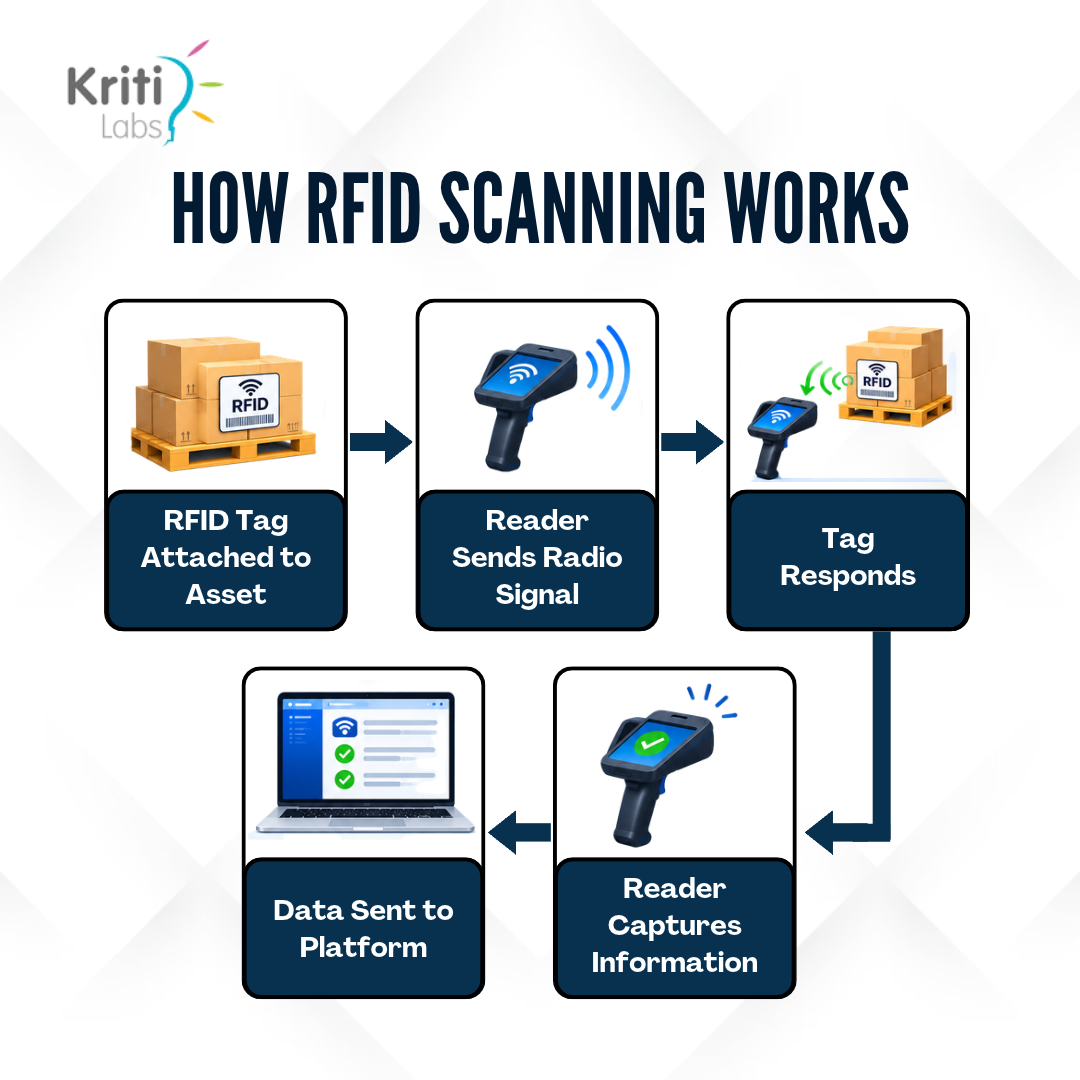
The process involves communication between an RFID reader and a tag attached to an object. While the underlying technology can vary, the basic process follows four steps.
1. RFID Tags Are Attached to Assets
Each asset, product or container is fitted with an RFID tag containing electronically stored information. This information typically includes a unique identification number that can be associated with an asset record in a software system.
RFID tags are available in different forms depending on the application and operating environment.
Two common categories are:
- Passive RFID tags: These do not have their own power source. They use energy from the radio frequency signal transmitted by the reader to communicate their stored information.
- Active RFID tags: These contain an internal power source and can transmit signals over longer distances, depending on their design.
2. The RFID Reader Sends a Radio Signal
When an RFID reader is activated, it generates radio frequency signals within its operating range.
These signals interact with compatible RFID tags in the surrounding area. The reading range depends on factors such as frequency, tag design, reader capability and the environment in which the system operates.
3. The RFID Tag Responds
When a compatible tag receives the reader's signal, it communicates its stored identification information back to the reader.
The reader captures this information and makes it available for further processing.
Depending on the system configuration, multiple tags can be identified during the same scanning operation. This can reduce the need for employees to locate and scan every item individually.
4. Information Is Transferred to a Software Platform
The reader transfers the captured information to a connected application or software platform.
The system can then use this data to update asset records, verify inventory, log scan events or record the presence of specific items at a designated location.
For example, when an employee scans RFID tags attached to equipment in a warehouse, the system can record which assets were detected and when the verification took place.
This connects physical assets with digital records, making identification and verification easier to manage.
RFID Scanning vs Barcode Scanning: What Is the Difference?
Both RFID and barcode technologies help businesses identify products and assets. However, they work differently and suit different operational requirements.
| Parameter | RFID Scanning | Barcode Scanning |
|---|---|---|
| Technology | Radio frequency signals | Optical scanning |
| Line of sight | Not always required | Generally required |
| Multiple item identification | Yes, system dependent | Individual scanning |
| Data storage | Electronic information stored on a tag | Information represented through a printed code |
| Physical condition | Suitable tags can withstand specific operating conditions | Printed codes can become damaged or difficult to read |
| Typical applications | Asset identification, inventory verification and logistics | Retail billing, product identification and inventory checks |
RFID is particularly useful when businesses need to identify multiple tagged items or verify assets without locating every tag visually.
However, barcode systems can be more economical and practical for simpler identification requirements. The right choice depends on the number of assets, operating environment, reading requirements and available infrastructure.
Where Do Businesses Use RFID Scanning?
RFID scanning has applications across industries that need to identify, verify and manage physical assets.
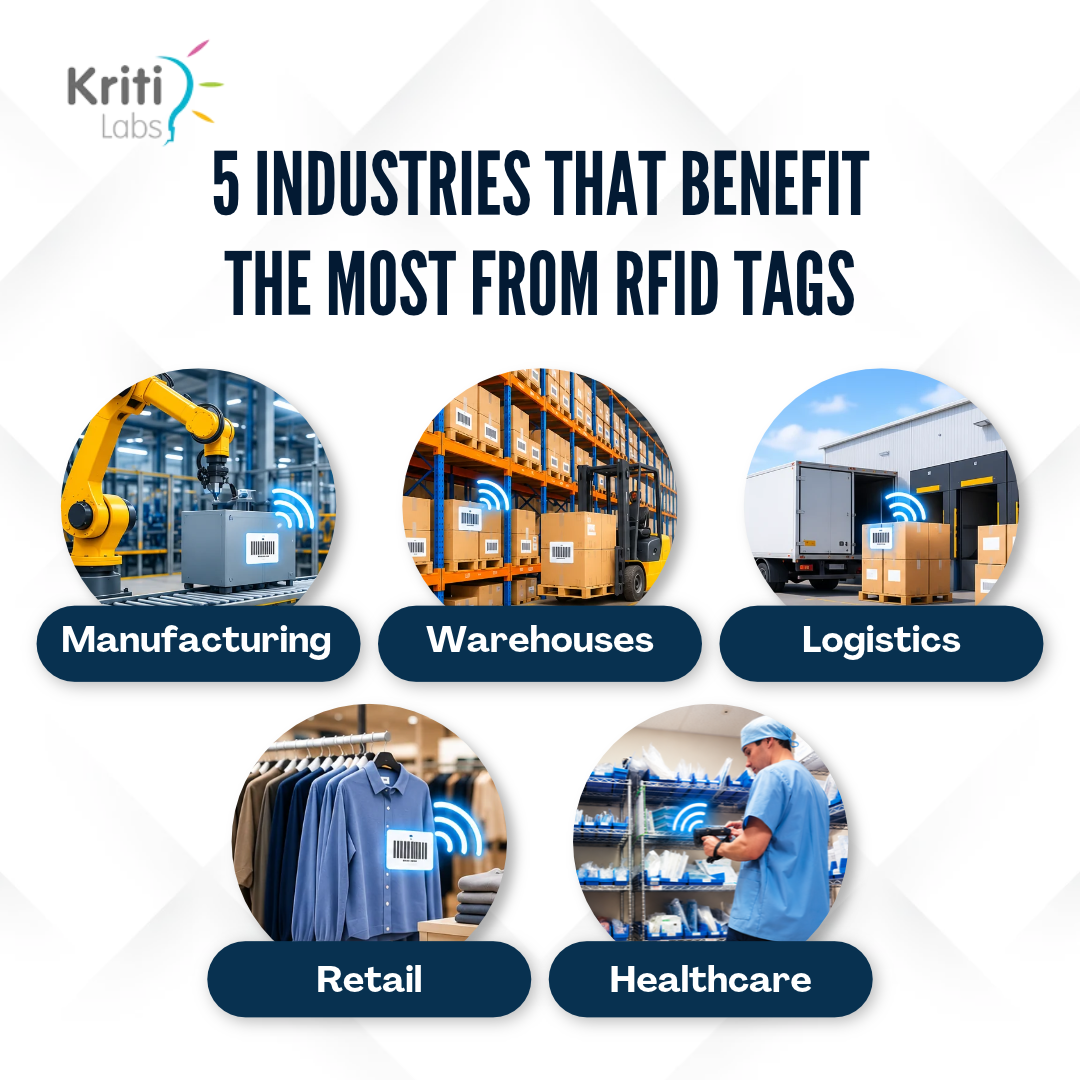
1. Manufacturing and Industrial Facilities
Manufacturing facilities often manage large numbers of tools, equipment, components and machinery. RFID tags can help identify these assets and support periodic verification.
For example, employees can use handheld RFID readers to check whether designated equipment is present within a production facility. Scan records can help maintain asset registers and improve accountability.
2. Warehousing and Inventory Management
Warehouses handle frequent movements of products between receiving areas, storage locations and dispatch points.
RFID scanning can support inventory verification, stock identification and movement recording. It can also help employees check tagged items during receiving and dispatch operations.
When connected to inventory software, scanned information can contribute to more accurate digital stock records.
3. Logistics and Cargo Transportation
Logistics operations require businesses to identify cargo, verify shipments and maintain records during transportation.
RFID tags can be used to identify containers, packages and other tagged assets at designated checkpoints. This supports cargo verification during loading, unloading and movement between facilities.
RFID-enabled electronic seals can also provide additional security information when used in suitable transportation systems.
4. Facility and Equipment Management
Organisations managing multiple facilities often need to verify the presence of equipment across different buildings and operational areas.
RFID scanning can simplify periodic asset checks and help maintain records of equipment identification and verification activities.
This is particularly useful when employees need to conduct regular audits or confirm that designated assets remain within specified premises.
What Are the Benefits of RFID Scanning?
RFID scanning can improve several aspects of asset and inventory management.
Reduced manual effort: Employees can identify tagged assets without manually recording every identification number. This can simplify repetitive verification activities.
Faster asset verification: RFID readers can identify multiple tags within their reading range, depending on the system and operating conditions.
Improved record accuracy: Automated data capture reduces dependence on manual entries, helping minimise errors in asset records.
Better accountability: Timestamped scan records provide information about when verification activities took place.
Improved asset visibility: When connected to a software platform, scanned information can help organisations maintain updated records of asset presence and status.
It is important to understand that RFID scanning does not automatically provide continuous location tracking. A conventional RFID scan confirms that a tag was detected by a reader at a particular time and location. Continuous tracking requires additional infrastructure or technologies designed for that purpose.
Choosing the Right RFID Scanning System
Selecting an RFID solution requires more than choosing a reader and attaching tags to assets. Businesses should consider how the technology will fit into their existing operations.
Some important factors include:
- Frequency and compatibility: The RFID tags and readers must operate on compatible frequencies and standards.
- Tag suitability: Tags should be appropriate for the assets, materials and environmental conditions involved.
- Reader type: Handheld readers are useful for mobile asset verification, while fixed readers can support scanning at designated locations.
- Reading range: Businesses should evaluate the distance at which assets need to be identified.
- Software integration: Scanned information should connect to an asset management or inventory platform.
- Scalability: The solution should accommodate current asset volumes and future operational requirements.
A well-planned implementation considers the complete process, from tagging physical assets to making the captured information useful for employees and management.
How KritiLabs Uses RFID Scanning for Asset Management and Security
KritiLabs uses RFID technology through solutions such as E-Baton and SmartSeal to support asset identification, verification and cargo security.
E-Baton: Handheld RFID Scanning for Asset Verification
E-Baton is a handheld device equipped with an RFID reader that scans tags attached to assets. It transmits the captured information, along with timestamps, through Wi-Fi to the KritiLabs AI²oT platform.
A user dashboard provides access to asset information, allowing organisations to verify the presence of tagged assets within specified premises such as factories and warehouses.
This makes E-Baton relevant to manufacturing, warehousing and logistics operations where regular asset identification and verification are required.
SmartSeal: RFID-Based Security for Cargo
KritiLabs SmartSeal is an electronic seal featuring an integrated RFID tag that activates when the seal is locked. It is designed to provide tamper-evident security and traceability for assets during storage and transportation.
When used alongside E-Baton, the RFID information from SmartSeal can be read and transmitted to the AI²oT platform, supporting cargo verification during loading, transportation and unloading.
Together, these solutions connect RFID-based identification with asset management and transportation security, helping businesses maintain better records and visibility across their operations.
Conclusion: Making Asset Identification More Efficient
RFID scanning provides businesses with a practical way to identify and verify physical assets without depending entirely on manual records or individual barcode scans. Its applications extend across manufacturing, warehousing, logistics and facility management.
When connected to a software platform, RFID data becomes more useful for maintaining asset records, conducting verification checks and supporting operational decisions.
Solutions such as KritiLabs E-Baton and SmartSeal demonstrate how RFID technology can be applied to asset management and cargo security, helping organisations improve visibility and accountability across their operations.