
Why the Way You Manage Facilities Matters More Than Ever
Managing a modern facility involves much more than maintaining buildings and equipment. Facility teams are responsible for maintenance, security, housekeeping, energy monitoring, service requests and several other operational activities. Each function plays an important role, but managing them independently can create gaps in visibility and coordination.
Many organisations still rely on separate applications, spreadsheets and monitoring systems for different facility operations. While these tools may serve their individual purposes, disconnected information makes it harder to understand what is happening across an entire facility.
This is where integrated facility management becomes important. By connecting systems, teams, assets and workflows, organisations can move towards more coordinated and efficient facility operations.
What Are Siloed Facility Management Systems?
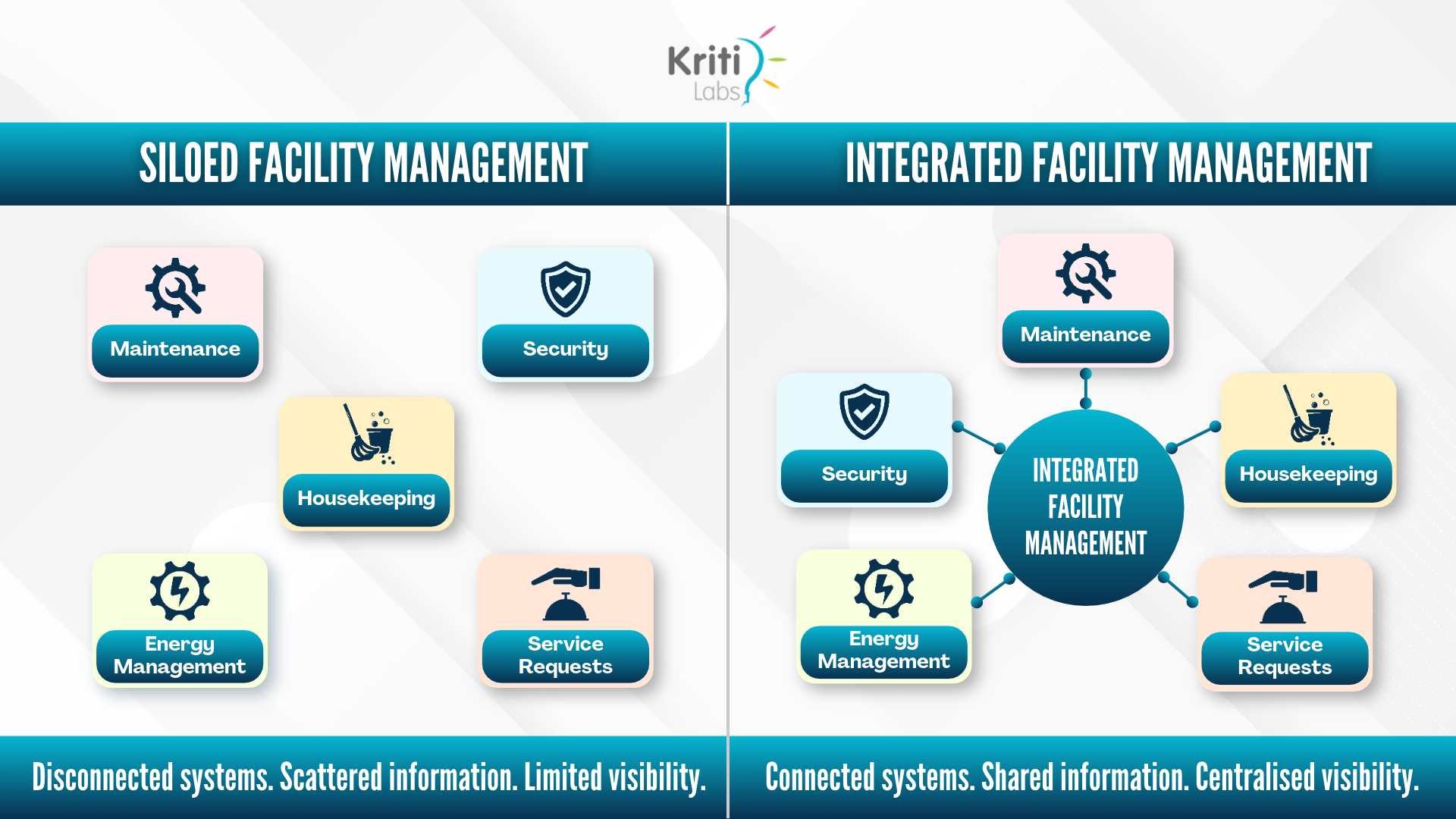
Siloed facility management refers to an approach where different operational functions are managed through separate systems that do not effectively communicate with one another.
For example, a maintenance team may use one application to track equipment breakdowns, while the security team operates an independent surveillance system. Housekeeping requests may be recorded through spreadsheets or emails, and energy monitoring data may be available through another dashboard.
Each system collects useful information, but the data often remains within its respective department.
This creates several operational challenges:
- Scattered information: Managers need to access multiple systems to understand the overall status of facility operations.
- Limited coordination: Teams may not receive relevant information from other departments in a timely manner.
- Manual reporting: Consolidating information from different applications can consume considerable time.
- Delayed responses: Service requests and incidents may take longer to reach the appropriate personnel.
- Limited operational visibility: Identifying recurring issues or understanding their impact across departments becomes difficult.
The problem is not necessarily the individual tools. It is the lack of connection between them.
What Is Integrated Facility Management?
Integrated facility management brings different facility functions into a connected operational environment. Instead of managing maintenance, security, service requests and infrastructure monitoring independently, organisations can coordinate these activities through a common platform.
An integrated approach typically involves five important elements:
1. Centralised information
Relevant operational data from different departments, systems and devices is made available through a common interface. Managers gain a broader view of facility activities without constantly switching between applications.
2. Connected systems and infrastructure
Existing applications, IoT devices, sensors, cameras and other infrastructure can be connected to share relevant information.
3. Unified workflows
Service requests, complaints, incidents and maintenance activities can be recorded, assigned and tracked through structured workflows.
4. Real-time visibility
Managers can monitor relevant operational conditions, outstanding requests and ongoing activities through centralised dashboards.
5. Consolidated reporting
Information from different operational functions can be reviewed together, helping management identify recurring issues and evaluate performance.
Importantly, integration does not always require replacing existing systems. A suitable platform can connect with existing infrastructure and applications, depending on their compatibility and integration requirements.
Integrated Facility Management vs Siloed Systems: What Is the Difference?
The difference becomes clearer when we compare how both approaches handle everyday facility operations.
| Operational area | Siloed systems | Integrated facility management |
|---|---|---|
| Data management | Information stored across separate applications | Relevant information brought together in a common environment |
| Maintenance | Activities tracked independently | Maintenance workflows connected to operational information |
| Service requests | Requests handled through different channels | Requests recorded, assigned and tracked through unified workflows |
| Monitoring | Separate dashboards for different functions | Centralised operational visibility |
| Incident management | Information communicated between teams separately | Events can be linked to relevant teams and workflows |
| Reporting | Reports compiled manually from multiple sources | Consolidated operational reporting |
| Decision-making | Decisions based on fragmented information | Decisions supported by a broader operational view |
| Scalability | Additional systems can increase complexity | New systems and locations can be integrated as requirements evolve |
Consider a common situation: a facility experiences an equipment breakdown.
In a siloed environment, the issue may be reported through a phone call or email. The maintenance team records it separately, while the facility manager may have to follow up manually to understand its status.
In an integrated environment, the issue can be recorded as a service request, assigned to the relevant team and tracked through a centralised workflow. Managers can review its status and access related operational information from the same platform.
The difference is not simply about having fewer applications. It is about making information and processes work together.
Why Should Facility Management Leaders Move Towards Integrated Operations?
For FM leaders, integration is valuable because it improves how different operational activities are coordinated and monitored.
Better Coordination Between Teams
Maintenance, housekeeping, security and facility teams often depend on information from one another. A connected environment makes it easier to share relevant updates, assign responsibilities and track outstanding activities.
Faster Identification and Resolution of Issues
When service requests, complaints and incidents are managed through structured workflows, relevant personnel can be notified and responsibilities can be assigned more clearly. Managers also have better visibility into pending and completed activities.
Improved Operational Visibility
Instead of accessing multiple applications to understand facility performance, managers can review relevant information through centralised dashboards. This is particularly useful when overseeing large facilities or multiple locations.
More Informed Maintenance Decisions
Connecting equipment information, maintenance records and operational alerts can help teams identify recurring issues. This supports better maintenance planning and reduces dependence on fragmented records.
Better Control Across Multiple Locations
Organisations managing several buildings or facilities need consistent reporting and visibility. An integrated platform can bring information from different locations into a common operational environment, making it easier to monitor activities and compare performance.
The Role of IoT and Automation in Integrated Facility Management
Integration becomes more useful when facility systems can exchange information and respond to changing conditions.
IoT devices and sensors can collect data about parameters such as temperature, pressure, water levels and equipment conditions. Cameras and access control systems provide additional information about security and facility activity.
This information can be processed locally through edge computing or shared with a central platform for monitoring and analysis.
Automation adds another layer of functionality. For example, when a configured condition is detected, the system can generate a notification, initiate a service request or trigger a predefined workflow.
The combination of IoT, analytics and automation helps facility teams move beyond manual data collection. Instead of checking individual systems at regular intervals, they can receive relevant information and respond based on defined operational conditions.
How KritiLabs REMP Connects Facility Operations
KritiLabs' Realtime Enterprise Management Platform (REMP) is designed to bring people, assets, infrastructure and operational workflows together in a connected environment.
Rather than treating every facility function as a separate activity, REMP provides a common platform for managing relevant operational information and processes.
Its capabilities include:
- Centralised operational dashboards: Providing visibility into facility activities and relevant operational information.
- Service request and complaint management: Helping teams record, assign, track and manage service requests.
- Incident and maintenance workflows: Supporting structured handling of operational issues and maintenance activities.
- IoT and system integration: Connecting relevant devices, infrastructure and enterprise systems.
- Reporting and analytics: Helping managers review operational information and identify areas requiring attention.
- AI Assistant: Supporting access to operational insights and information.
REMP can integrate with IoT devices and other enterprise systems, helping organisations bring information from different sources into a common operational environment.
For facility managers, this means having a more connected view of ongoing activities, outstanding requests and operational performance. It also provides a foundation for improving coordination between teams and managing multiple locations.
The objective is to make facility operations easier to monitor, coordinate and manage, rather than adding another disconnected application to the technology stack.
What Should FM Leaders Look for in an Integrated Facility Management Platform?
Choosing an integrated facility management platform requires more than comparing feature lists. FM leaders should evaluate whether the platform addresses their actual operational requirements.
Some important considerations include:
- Integration capabilities: Can the platform connect with existing applications, devices and infrastructure?
- Centralised dashboards: Does it provide a useful overview of operational activities?
- Workflow management: Can service requests, incidents and maintenance activities be assigned and tracked?
- IoT compatibility: Can it collect and process information from relevant sensors and connected devices?
- Scalability: Can it support additional facilities, locations and operational requirements?
- Ease of use: Can facility teams and management use it without unnecessary complexity?
- Data security: Does it provide appropriate access controls and safeguards for operational information?
The right platform should fit into the organisation's existing environment while supporting its future requirements.
Conclusion: Moving Towards More Connected Facility Operations
Siloed systems may help individual departments manage their responsibilities, but they often limit visibility across the facility as a whole. As operational requirements become more complex, connecting information, teams and workflows becomes increasingly important.
Integrated facility management provides a more coordinated approach by bringing different systems and processes into a common operational environment. IoT, automation and analytics further strengthen this approach by making facility information more accessible and actionable.
With platforms such as KritiLabs REMP, organisations can connect people, assets, infrastructure and workflows, moving towards more informed and coordinated facility management.