
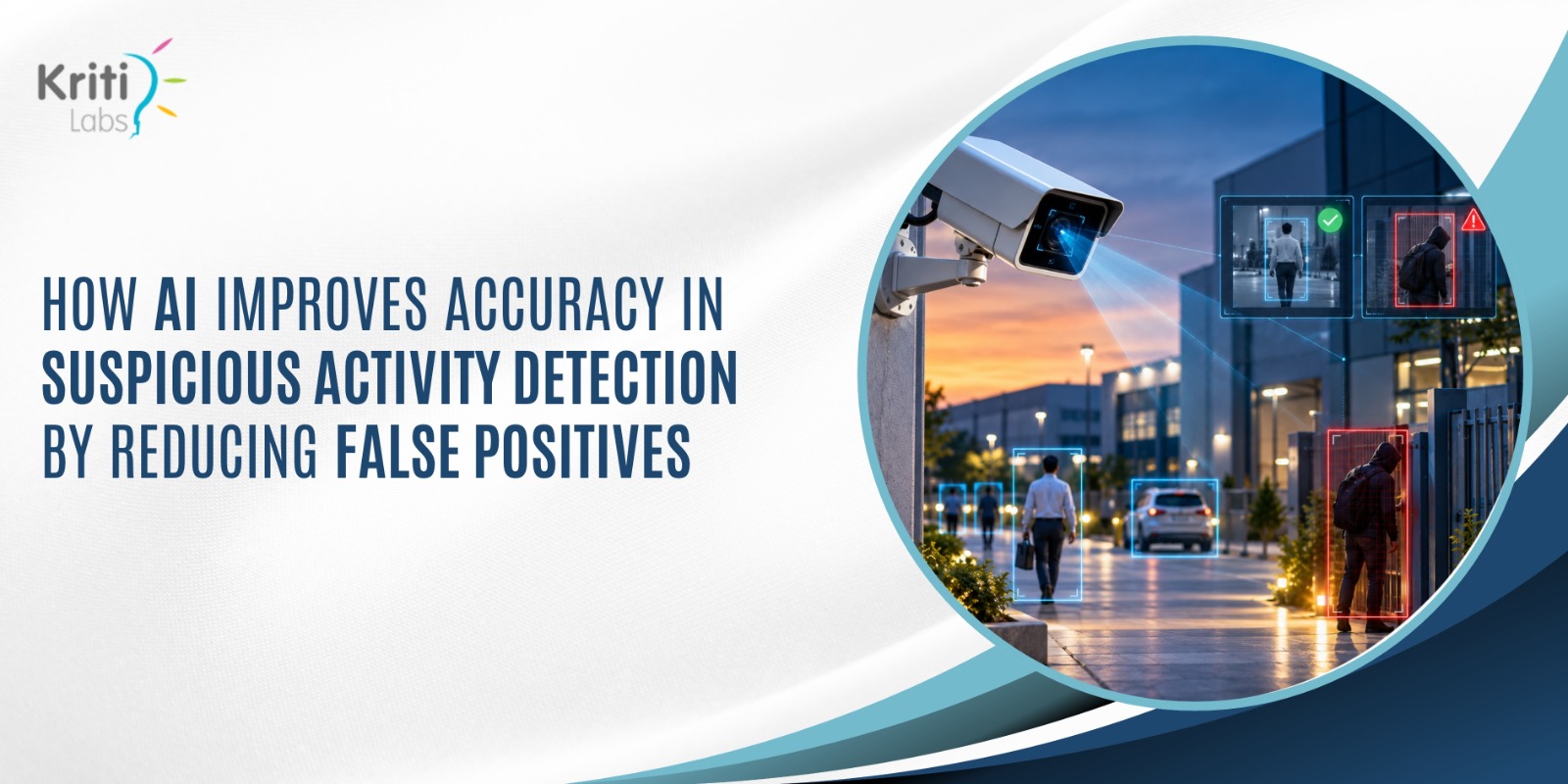
Why Accurate Suspicious Activity Detection Matters More Than Ever
Security teams are expected to monitor large premises, multiple entry points and hundreds of camera feeds. Yet traditional surveillance systems often generate alerts for ordinary events such as passing vehicles, changing light conditions or people moving through monitored areas. These false positives consume valuable time and make it harder to identify genuine security concerns.
AI-powered video analytics is changing how organisations approach surveillance. Instead of responding to every instance of movement, AI systems can analyse objects, recognise patterns and assess activity against defined security conditions. This helps security teams focus on events that require attention, making monitoring more accurate and efficient.
Why Do Traditional Surveillance Systems Generate False Positives?
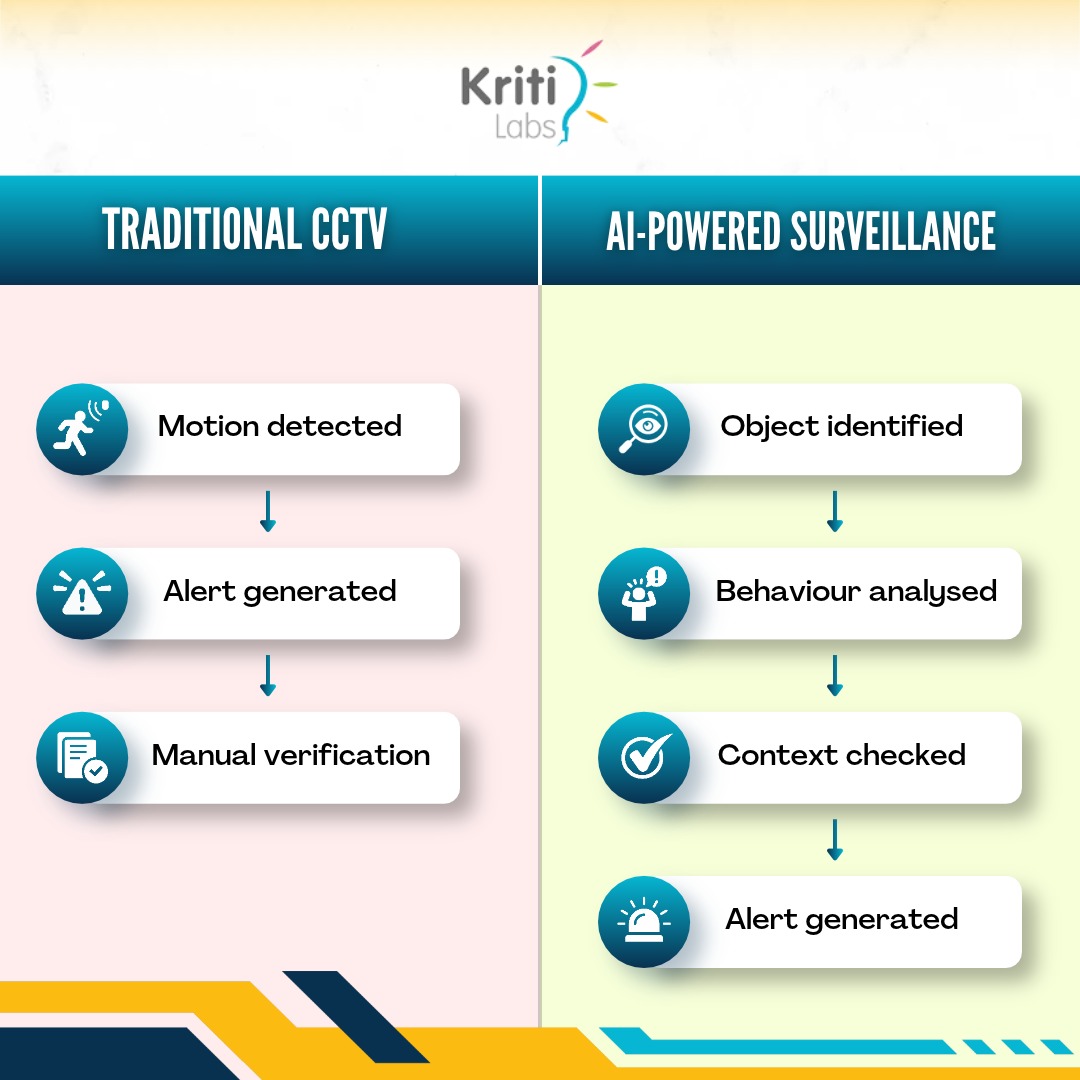
Conventional CCTV systems are primarily designed to capture and record footage. Basic motion detection can identify changes within a camera's field of view, but it does not necessarily understand what caused the movement or whether it represents a security risk.
Several factors contribute to unnecessary alerts:
- Environmental changes: Shadows, reflections, rain, fog and variations in lighting can trigger motion-based alerts.
- Routine movement: Employees, visitors and authorised vehicles moving through monitored areas may be flagged repeatedly.
- Unclear security boundaries: Movement near a restricted zone may be mistaken for an actual intrusion.
- Limited contextual awareness: Basic systems cannot reliably distinguish between normal activity and behaviour that requires investigation.
- Manual monitoring limitations: Security personnel monitoring multiple camera feeds may struggle to identify every relevant event while filtering out routine activity.
Over time, a high volume of irrelevant alerts can lead to alert fatigue. When teams become accustomed to receiving frequent notifications that do not require action, their ability to prioritise genuine incidents can suffer.
The challenge, therefore, is not simply to detect movement. It is to understand what is happening and determine whether it warrants attention.
How AI Reduces False Positives in Suspicious Activity Detection
AI improves surveillance accuracy by analysing video beyond basic motion detection. It can identify objects, interpret movement patterns and apply rules based on the location and nature of an activity.
1. Object Detection and Classification
An AI-powered video analytics system can identify and classify objects such as people and vehicles within a camera feed. This is an important first step because not every movement in a monitored area has the same significance.
For example, movement caused by a passing vehicle, a person entering a building or an object moving due to environmental conditions should not automatically trigger the same type of alert.
By recognising what is present in a video frame, AI can help filter out irrelevant movement and focus on the objects associated with a particular security requirement.
2. Analysing Behaviour and Movement Patterns
Detecting an object is only part of the process. Understanding how it moves can provide additional context.
AI-based video analytics can be configured to identify activities such as loitering, unusual movement, restricted-area entry and potential intrusion. Rather than reacting to a single moment, the system can analyse movement over a period of time.
Consider a person walking past a restricted entrance. A basic motion detection system may generate an alert simply because movement has occurred. An AI-based system can be configured to consider factors such as how long the person remains in the area or whether they enter a designated restricted zone.
This additional analysis helps distinguish routine movement from activity that may need investigation.
3. Applying Context to Security Alerts
The same activity can have different meanings depending on where and when it occurs.
A person walking through a reception area during business hours is generally routine. The same person remaining near a restricted access point outside operating hours may warrant closer attention.
AI-based surveillance systems can use configured detection zones, time-based rules and activity conditions to make alerts more relevant.
This does not mean AI independently understands every possible situation. Its effectiveness depends on how detection rules are configured and how well they reflect the organisation's security requirements.
4. Combining Video Analytics with Other Data
Video footage can provide a clearer picture when considered alongside information from other connected systems.
For example, an access control system may record an authorised entry while a camera captures the corresponding activity. When video analytics and access-related information are integrated, security teams can assess an event using more than one source of information.
Similarly, relevant IoT sensors can provide additional inputs for specific monitoring requirements.
This connected approach helps reduce dependence on isolated alerts and gives security personnel more information when evaluating an event.
The Role of Edge AI in Real-Time Security Monitoring
The speed at which a security system processes video can influence how quickly teams receive alerts.
In a conventional cloud-dependent setup, video data may need to travel to a remote server for processing. Edge computing offers another approach by allowing AI modules to analyse video closer to the camera or monitoring location.
This has several practical advantages:
- Faster processing: Local analysis can reduce delays in detecting time-sensitive events.
- Reduced dependence on connectivity: Certain analytics and time-critical alerting functions can operate locally.
- Efficient data transmission: Processed information and relevant event details can be sent to central systems instead of continuously transmitting every raw video feed.
- Immediate notifications: Critical events can trigger alerts for authorised personnel without waiting for a complete remote processing cycle.
Edge AI does not automatically eliminate false positives. However, when combined with suitable detection models and correctly configured rules, it supports faster and more responsive security monitoring.
Where Accurate Suspicious Activity Detection Makes a Difference
Reducing unnecessary alerts is valuable wherever security teams monitor large or active environments.
Manufacturing facilities: AI can help identify unauthorised entry into restricted production areas while distinguishing it from routine employee movement.
Warehouses and logistics hubs: Monitoring can focus on unusual activity near storage areas, loading zones and other sensitive locations.
Banking and financial institutions: AI-based surveillance can support the detection of loitering, unauthorised access and other events that require security attention.
Corporate campuses: Security teams can monitor entrances, designated restricted areas and common spaces without relying entirely on continuous manual observation.
Public infrastructure: AI video analytics can help monitor sensitive locations and identify activity that falls outside configured security conditions.
In each case, the objective is not to generate an alert for every movement. It is to help security teams identify relevant events and respond appropriately.
How KritiLabs VAIOT Supports Intelligent Video Surveillance
KritiLabs' VAIOT solution uses AI and deep learning to transform existing video surveillance networks into systems that can identify objects, analyse video feeds and generate actionable information.
Rather than requiring organisations to replace their entire CCTV infrastructure, VAIOT can use existing cameras as video input sources. The video feeds are processed through edge devices running AI modules, which analyse activity and identify events relevant to configured use cases.
Its capabilities include:
- Object detection and classification: Identifying and classifying objects within video feeds for further analysis.
- Edge-level processing: Analysing video locally to support real-time detection and time-sensitive alerts.
- Real-time alerting: Notifying authorised personnel when configured events are detected.
- Centralised dashboards: Providing visibility into processed information, incident logs and historical data through the AI²oT platform.
- Visualisation and reporting: Helping security teams review events, access relevant information and make informed decisions.
By bringing video analytics, edge processing and connected monitoring together, VAIOT helps organisations make better use of their existing surveillance infrastructure.
The result is a more structured approach to security monitoring, where teams can spend less time reviewing irrelevant notifications and more time investigating events that require attention.
What Should Organisations Consider When Implementing AI-Based Surveillance?
AI can improve detection accuracy, but the results depend on how the system is deployed and maintained. Organisations should consider a few important factors before implementation:
- Camera quality and placement: Poor visibility, unsuitable camera angles and inadequate lighting can affect detection performance.
- Detection requirements: Models and rules should be configured around the specific activities and security risks an organisation wants to monitor.
- Environmental conditions: Systems should be evaluated under actual operating conditions, not just controlled demonstration environments.
- Integration: Existing CCTV, access control and relevant IoT systems should work together where required.
- Continuous evaluation: Security teams should review alerts, identify recurring false positives and fine-tune detection parameters over time.
Human oversight also remains important. AI can identify and flag events, but security personnel provide the judgement needed to assess unusual situations and decide on the appropriate response.
Conclusion: Making Security Alerts More Meaningful
The effectiveness of a surveillance system should not be measured by the number of alerts it generates. It should be measured by how reliably it helps security teams identify events that matter.
AI improves suspicious activity detection by combining object recognition, movement analysis and contextual rules. When supported by edge processing and connected monitoring systems, it can make surveillance more responsive and reduce the burden of unnecessary notifications.
With solutions such as KritiLabs VAIOT, organisations can extend the capabilities of their existing CCTV infrastructure and move towards more intelligent, event-driven security monitoring.