
.jpeg)
The Future of Facility Management Systems: IoT, AI & Automation
Facility management is no longer limited to maintaining buildings, responding to service requests and keeping equipment operational. As facilities become larger, more connected and more dependent on technology, facility teams need a clearer view of what is happening across assets, infrastructure, people and operations.
The challenge is that many organisations still manage these areas through separate systems, spreadsheets, manual inspections and disconnected workflows. Information may exist, but it is often spread across different teams and applications.
The future of facility management systems is moving towards a more connected model. IoT provides real-time data, AI helps interpret that data, and automation helps turn insights into action. When these capabilities work through one platform, facility teams can move from reactive management towards more proactive and coordinated operations.
Why Traditional Facility Management Systems Are Becoming Difficult to Scale
A facility may have separate systems for security, maintenance, access control, energy monitoring, asset management and service requests. Each system can perform its individual function, but managing them together can become difficult as operations grow.
Consider a maintenance issue involving a critical piece of equipment. A sensor may detect abnormal temperature, but the maintenance team may still depend on a separate system or manual communication to receive the information. Security incidents, service requests and asset information may follow completely different processes.
This creates several practical challenges:
- Limited visibility across operations
- Delayed communication between teams
- Manual coordination of incidents and service requests
- Difficulty tracking issues across multiple locations
- Data distributed across different systems
- Delays between identifying a problem and taking action
A future-ready facility management system needs to bring these operational elements closer together instead of simply adding another isolated software application.
The Role of IoT in Modern Facility Management
The Internet of Things changes facility management by allowing physical assets and equipment to generate operational data continuously.
Sensors can monitor parameters such as temperature, pressure, energy consumption, equipment status, occupancy and other conditions depending on the facility and application. This data can provide facility teams with information that is difficult to obtain through periodic manual inspections alone.
For example, instead of discovering an equipment problem during a scheduled inspection, a connected sensor may identify an abnormal operating condition earlier. Similarly, facility managers can monitor the status of assets across multiple locations without physically checking every site.
IoT therefore becomes the data layer for modern facility management.
But collecting data is only the beginning. A facility management system also needs to determine what that data means and what should happen next.
How AI Turns Facility Data Into Operational Intelligence
Large facilities can generate substantial amounts of operational data. Reviewing every data point manually is neither practical nor efficient.
This is where AI can add another layer of intelligence.
AI can analyse incoming information, identify unusual patterns and help teams focus on events that require attention. Depending on the application, this could involve identifying abnormal equipment behaviour, analysing video feeds, detecting unusual activity or recognising patterns that may indicate an emerging problem.
The value comes from moving beyond simple monitoring.
A dashboard showing hundreds of sensor readings may provide visibility, but an intelligent system can help identify which readings matter and why they matter.
For facility management teams, this can support:
- Earlier identification of abnormal conditions
- More focused maintenance decisions
- Faster response to operational incidents
- Analysis of recurring problems
- Better use of historical operational data
- Improved planning based on actual performance
KritiLabs' broader technology approach combines AI, IoT, data analytics and automation to support real-time monitoring, connected assets and operational decision-making.
Automation Closes the Gap Between Detection and Action
Even when a facility management system identifies a problem quickly, the next step can still depend on people.
An alert may need to be reviewed, a technician contacted, a service request created and the resolution tracked. If every step requires manual coordination, response time can still suffer.
Automation helps connect these stages.
For example:
Sensor detects an abnormal condition → system generates an alert → workflow is triggered → responsible team is notified → task is assigned → resolution is tracked.
The exact workflow will depend on the facility and its operating requirements. The important change is that the system can connect detection with the appropriate operational process.
Automation can also help standardise recurring workflows. Instead of relying on individual employees to remember what should happen after a particular event, predefined processes can guide the response.
This is particularly useful when facilities operate across multiple buildings, locations or departments.
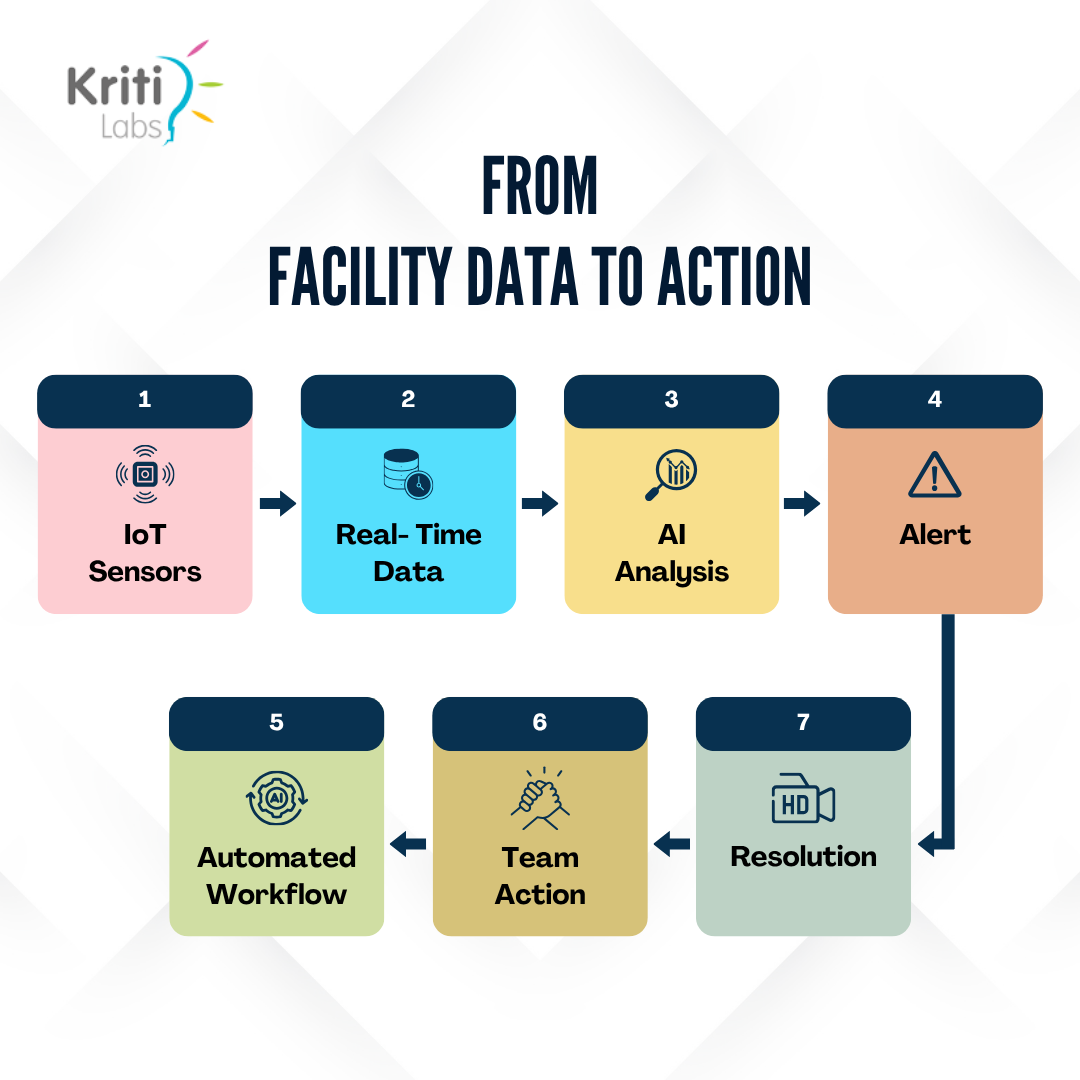
One Platform Can Connect the Entire Facility Management Workflow
IoT, AI and automation become more useful when they are not operating as isolated technologies.
A connected facility management environment can bring together:
Physical assets
Equipment, machinery, vehicles, infrastructure and other critical assets.
Connected devices
Sensors, cameras, access control devices and other IoT equipment.
Operational information
Alerts, incidents, service requests, maintenance activities and performance data.
People and teams
Facility managers, maintenance teams, security personnel and other operational users.
Workflows
The processes that determine what happens when an issue is detected.
Instead of asking facility managers to move between several systems, a unified platform can provide a common operational view.
This does not necessarily mean replacing every existing system. Integration is important because many organisations already have established enterprise applications and operational infrastructure.
The objective is to connect relevant information and workflows so that teams can work from a more consistent view of operations.
How KritiLabs REMP Brings IoT, AI and Automation Together
This is where the concept of a connected facility management system becomes particularly relevant to KritiLabs.
The Realtime Enterprise Management Platform (REMP) is designed to connect people, assets, infrastructure and operations through a single platform. It brings together IoT devices, enterprise systems and operational workflows into a unified dashboard.
For facility management, this approach can provide a central environment for monitoring assets and facilities, handling service requests, managing incidents and tracking maintenance workflows.
REMP provides a Centralized Operations Dashboard for viewing assets, facilities, operational activities, alerts and performance information across locations. It also supports complaint and service request management, task assignment and resolution tracking.
The platform also includes reporting and analytics capabilities to help organisations examine performance trends, identify inefficiencies and support operational planning.
This makes REMP relevant to a broader shift in facility management. Rather than treating IoT monitoring, maintenance, incidents and operational reporting as separate activities, they can form part of a connected management workflow.
REMP is designed for environments including corporate campuses, manufacturing facilities, logistics hubs, warehouses, smart infrastructure projects and government operations.
Real-Time Dashboards Change How Facility Managers Make Decisions
A dashboard is useful when it presents information that people can act upon.
Modern facility management dashboards can bring together asset status, alerts, service requests, incidents and performance indicators. This gives facility managers a more current picture of operations instead of relying primarily on periodic reports.
For organisations with multiple locations, this becomes even more important.
A central dashboard can help management identify which locations require attention, which issues remain unresolved and where operational performance is changing.
The goal is not to put more information on a screen. It is to make important information easier to find and act upon.
From Reactive Maintenance to Proactive Facility Management
Traditional maintenance often follows a reactive cycle:
Problem occurs → Issue reported → Technician responds → Repair completed
Connected systems can support a different approach:
Continuous monitoring → Anomaly detected → Early alert → Maintenance action → Issue prevented or reduced
This does not mean every equipment failure can be predicted or eliminated. Rather, continuous data collection gives maintenance teams more information with which to identify developing issues and prioritise work.
Over time, historical data can also help organisations understand recurring failures, maintenance patterns and asset performance.
This creates an opportunity to move maintenance planning from purely calendar-based or reactive processes towards decisions supported by actual operating conditions.
Where This Model Fits Across Different Facilities
The combination of IoT, AI and automation can be applied differently depending on the facility.
In manufacturing facilities, connected equipment and operational systems can provide visibility into machinery, maintenance requirements and production-related conditions.
In corporate campuses, the focus may include facilities, security, access, service requests, infrastructure and employee-facing operations.
In logistics and warehouse environments, organisations may need to monitor assets, facilities, security events and operational workflows across multiple locations.
For smart infrastructure and public-sector environments, centralised monitoring can help teams manage geographically distributed assets and respond to operational events.
The technology should therefore follow the operational requirement. Not every facility needs every sensor, AI capability or automated workflow.
What to Look for in a Future-Ready Facility Management System
As organisations evaluate facility management platforms, several capabilities are becoming increasingly relevant:
1. IoT connectivity
The platform should be able to collect and use data from relevant connected devices and sensors.
2. AI and analytics
It should help teams identify patterns, anomalies and useful operational insights rather than simply displaying raw data.
3. Workflow automation
Alerts should be capable of connecting with defined operational processes where appropriate.
4. Centralised visibility
Managers should be able to view important operational information without depending on multiple disconnected systems.
5. Integration
The platform should work with existing enterprise systems and infrastructure where required.
6. Multi-location support
Organisations managing several facilities should be able to maintain visibility across locations from a common environment.
7. Actionable reporting
Reports should help teams understand performance, identify recurring issues and support operational planning.
These capabilities matter because the future of facility management is not simply about adding more technology. It is about making different technologies work together in a way that supports everyday operations.
The Future Is Connected, Intelligent and Automated
Facility management is moving from isolated systems towards connected operational environments.
IoT can provide continuous information from physical assets and infrastructure. AI can help interpret that information and identify patterns that deserve attention. Automation can connect those insights with defined workflows and operational responses.
The next step is bringing these capabilities together.
A unified facility management system can provide the visibility needed by managers, the data needed by analysts, the workflows needed by operational teams and the intelligence needed to make faster decisions.
KritiLabs' REMP represents this approach by bringing assets, infrastructure, people and operations into a common platform with real-time monitoring, workflows, reporting and analytics.
For organisations planning the next stage of facility management, the question is increasingly not whether IoT, AI or automation should be used individually. It is how these technologies can work together to create a more connected and responsive operating environment.