
.jpeg)
How AI Is Changing Physical Security Planning for 2027
Security leaders are entering 2027 with a very different technology landscape from just a few years ago. AI is no longer limited to experimental projects. It is increasingly being used to analyse security events, prioritise alerts, monitor physical environments and support faster responses.
For organisations with multiple offices, manufacturing facilities, warehouses, logistics hubs or critical infrastructure, this shift is particularly relevant. Security teams may already have cameras, access control systems, sensors and alarm infrastructure in place. The challenge is turning all that information into something that can be acted upon quickly.
The focus is therefore moving from simply collecting security data to using AI to interpret events, identify risks and support timely action.
Here are seven AI-powered security solutions that security leaders should keep on their radar as they plan for 2027.
Why AI-Powered Security Is Becoming a Priority
Traditional CCTV and security systems provide valuable visibility, but they often depend heavily on people to monitor screens, review footage and identify incidents.
That approach becomes difficult to scale when an organisation has hundreds of cameras across several locations. Important events can be missed; alerts can be delayed and reviewing recorded footage can consume significant time.
AI changes the role of security infrastructure. Instead of cameras simply recording what happened, AI can analyse video and other data as events occur.
This is already happening across physical security. AI is being deployed within security platforms, as analytics engines that work with existing infrastructure and through edge devices that process information closer to where it is generated.
For CISOs and other security leaders, the opportunity is not simply to add another AI tool. It is to make existing security operations more intelligent, connected and responsive.
1. AI-Powered Video Analytics
AI-powered video analytics is one of the most practical applications of artificial intelligence in physical security.
Instead of requiring security personnel to continuously watch multiple camera feeds, computer vision systems can analyse video automatically and identify events that match predefined conditions.
Depending on the application, this can include:
- Unauthorised entry
- Suspicious movement
- Intrusion into restricted areas
- Unusual activity
- People and object detection
- Crowd and occupancy changes
- Safety-related events
This changes CCTV from a primarily reactive system into a source of real-time security intelligence.
KritiLabs' VAIOT solution is built around this approach. It can use existing CCTV cameras as input sources, process video through edge devices and use AI modules to identify and classify objects before sending relevant information to the AI²oT platform for alerts and visualisation.
This is also important from an investment perspective. Organisations do not necessarily need to replace their entire camera infrastructure to introduce AI capabilities. Integrating analytics with existing systems can provide a practical path towards more intelligent surveillance.
2. Intelligent Access Control
Access control is another area where AI can add context to security decisions.
Traditional access systems generally determine whether a credential, card or other authentication method is permitted. Intelligent systems can add another layer by using visual information and AI-based identification to assess who is attempting to enter and whether the event matches the organisation's security rules.
Applications can include:
- Restricted areas
- High-security facilities
- Employee access
- Visitor management
- Sensitive infrastructure
- Unauthorised access attempts
KritiLabs' visual security solutions combine video analytics, facial recognition, smart sensors and centralised dashboards to provide more intelligent access control and security monitoring.
The bigger opportunity comes when access control does not operate in isolation. An access event can be considered alongside video, sensor and incident information, giving security teams greater context around what is happening.
3. AI-Based Intrusion and Perimeter Monitoring
Large facilities can have extensive perimeters that are difficult to monitor effectively through conventional surveillance alone.
AI-based intrusion detection can help identify movement across defined boundaries or restricted zones and generate alerts when activity meets specific conditions.
This can be particularly useful for:
- Manufacturing plants
- Warehouses and logistics hubs
- Oil and gas facilities
- Utilities
- Government infrastructure
- Large corporate campuses
The distinction from access control is important. Access control determines whether someone should be allowed through a particular point. Perimeter monitoring focuses on whether someone or something has entered an area where it should not be.
KritiLabs combines cameras and motion sensors for intrusion detection and automated notifications, allowing security teams to respond to detected events more quickly.
4. AI-Powered Suspicious Activity Detection
Not every security incident begins with an obvious breach.
A person repeatedly moving around a restricted area, unusual movement near a sensitive asset or activity that does not match normal patterns may warrant investigation even when there is no immediate intrusion.
This is where suspicious activity detection can complement conventional rule-based security systems.
AI can help identify patterns such as:
- Loitering
- Unusual movement
- Sudden changes in direction
- Unauthorised activity
- Suspicious behaviour around restricted areas
The objective is not to replace security personnel's judgement. It is to help them focus their attention where it is most needed.
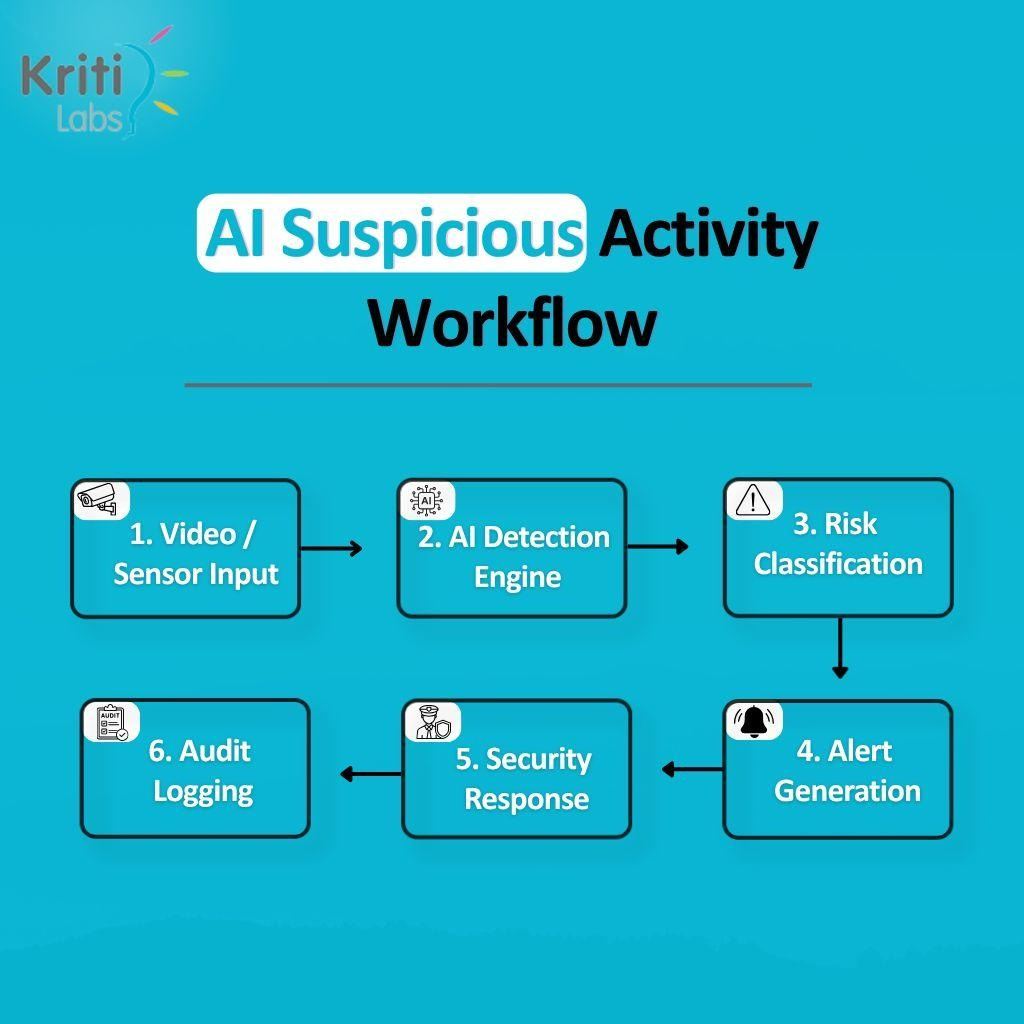
KritiLabs' suspicious movement tracking approach combines AI-based video analytics with IoT sensors, with detected activity moving through analysis, alerting and response stages.
This type of capability can become increasingly valuable as security teams move towards exception-based monitoring, where humans spend less time watching routine activity and more time investigating events that require attention.
5. AI-Based Occupancy and Crowd Monitoring
Security is not only about detecting intruders. Understanding how people move through a facility can also help organisations manage safety and security risks.
AI-based occupancy and crowd monitoring can provide real-time information about:
- Number of people in an area
- Crowd density
- Capacity levels
- Congestion
- Unusual gatherings
- Movement patterns
For example, a security team may need an alert when occupancy in a particular area exceeds a defined limit. In another environment, crowd information could help identify congestion before it creates a safety problem.
KritiLabs' visual analytics solutions include real-time occupancy and crowd monitoring, allowing organisations to use camera and sensor data for both security and operational visibility.
This is an important direction for AI security because the same infrastructure can support more than one function. A camera can contribute to security monitoring while also providing information relevant to safety and facility operations.
6. Edge AI for Real-Time Security
The location where AI processes information matters, particularly when security decisions need to happen quickly.
With edge AI, video and sensor data can be processed closer to the source rather than sending every piece of information to a remote server before analysis begins.
This can provide advantages such as:
- Lower latency
- Faster event detection
- Reduced dependence on continuous connectivity
- More efficient handling of video feeds
- Greater flexibility for distributed facilities
KritiLabs' VAIOT architecture uses edge devices to process video feeds and run AI modules locally, with processed information then passed to its AI²oT platform for alerts and visualisation.
For organisations managing large facilities or multiple locations, this approach can be particularly relevant where bandwidth, response time or connectivity are important considerations.
Edge AI also demonstrates why AI security is not simply about choosing a better algorithm. Deployment architecture can have a direct impact on how quickly and reliably a security system responds.
7. Centralised AI Security Monitoring
Adding individual AI capabilities can improve detection, but fragmented security systems can still create operational problems.
A camera system may sit in one environment, access records in another and alarms in a third. If security personnel must switch between multiple systems to understand an incident, the benefit of faster detection can be reduced.
A more connected approach brings together:
Cameras + Sensors + Access Control + AI Detection + Alerts + Incident Data + Dashboards
This allows security teams to monitor events through a common environment and gives decision-makers greater visibility across facilities.
KritiLabs' VAIOT combines existing CCTV infrastructure, edge processing, AI analytics, real-time alerts and visualisation through its AI²oT platform.
The broader industry is also moving in this direction. Current physical-security discussions increasingly focus on connecting video, access, alarms and incident workflows rather than treating each as an isolated system.
What Should Security Leaders Look for in 2027?
Having an AI feature does not automatically make a security solution useful.
As organisations evaluate technologies for 2027, security leaders should look beyond individual detection capabilities and consider how the solution fits into their existing environment.
Integration
Can it work with existing CCTV, access control and IoT infrastructure?
Accuracy
Can the system identify meaningful events without overwhelming operators with irrelevant alerts?
Scalability
Can the solution support additional cameras, devices, facilities and locations as the organisation grows?
Real-Time Response
Can an identified event reach the appropriate person quickly?
Data and Privacy
How is security data stored, accessed and protected, particularly when video or biometric information is involved?
Centralised Visibility
Can security teams understand what is happening across multiple locations without managing disconnected systems?
These considerations are becoming increasingly important as AI moves from individual detection features towards broader security operations. Industry guidance also points to governance, transparency, privacy and organisational readiness as important considerations when deploying AI in physical security.
From AI Detection to Intelligent Security Operations
The bigger change taking place is not simply that security systems are becoming better at detecting objects.
The progression looks more like this:
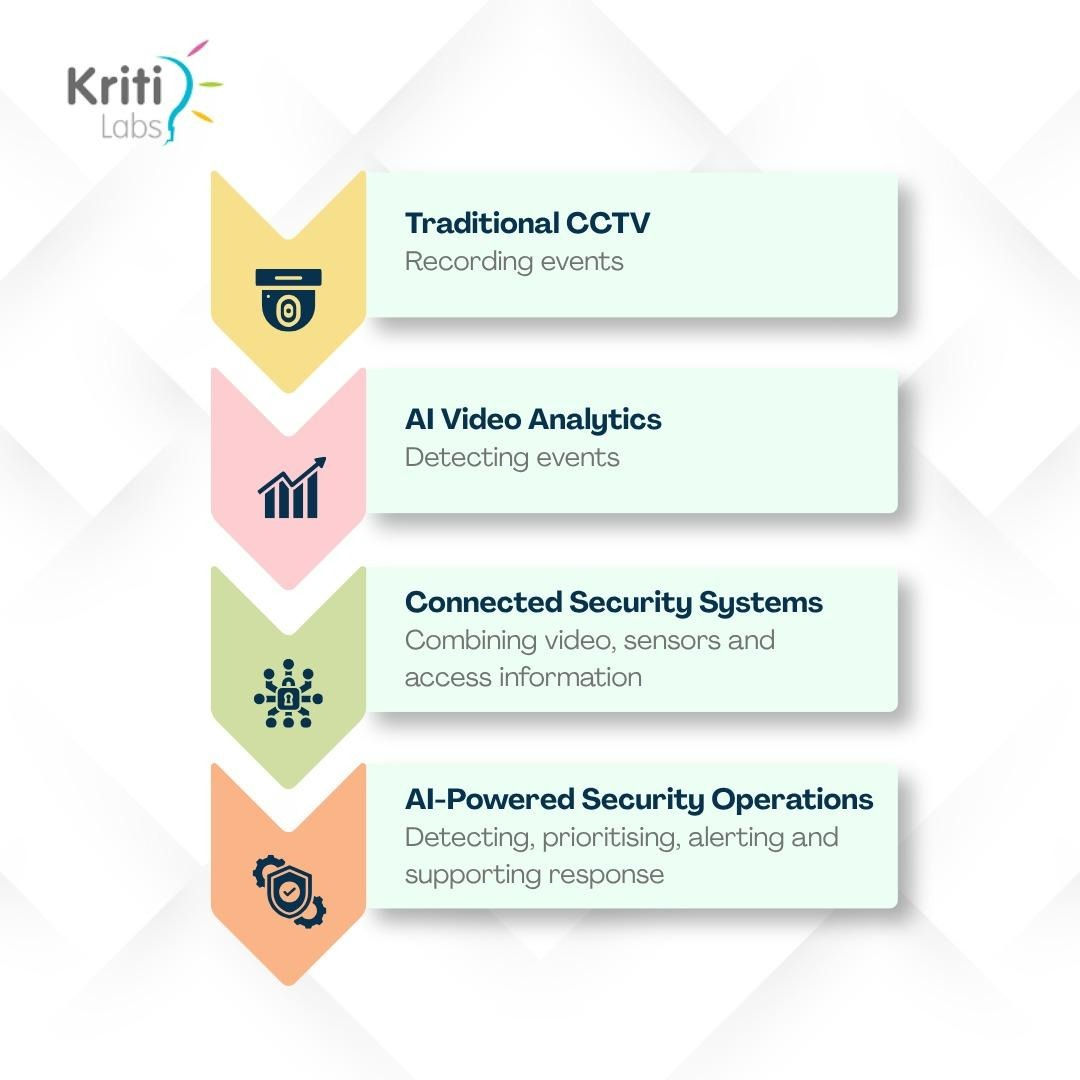 This distinction matters for 2027 planning.
A security system that can identify an event but leaves the team to manually investigate, communicate and document everything may still create operational delays.
The stronger model connects detection with context and response.
For KritiLabs, this is where AI, IoT, edge processing and visual analytics come together through solutions such as VAIOT. The objective is not simply to make cameras smarter, but to turn security data into information that teams can use.
Planning for a More Intelligent Security Environment
As CISOs and security leaders plan for 2027, AI-powered security deserves consideration as part of a broader move towards proactive security operations.
The right solution will depend on the organisation, its facilities, existing infrastructure and the risks it needs to manage. A manufacturing plant may prioritise perimeter monitoring and safety. A logistics hub may need occupancy, access and movement visibility. A corporate campus may place greater emphasis on access control and centralised monitoring.
The common requirement is the ability to identify important events earlier and respond with better information.
KritiLabs approaches this through AI-powered visual analytics, IoT integration, edge processing and centralised monitoring. Its VAIOT platform can work with existing CCTV infrastructure and turn video feeds into AI-generated insights, alerts and visual information.
For security leaders looking towards 2027, the question is therefore not simply whether to adopt AI.
It is where AI can make the biggest difference to how security teams detect, understand and respond to risk.