
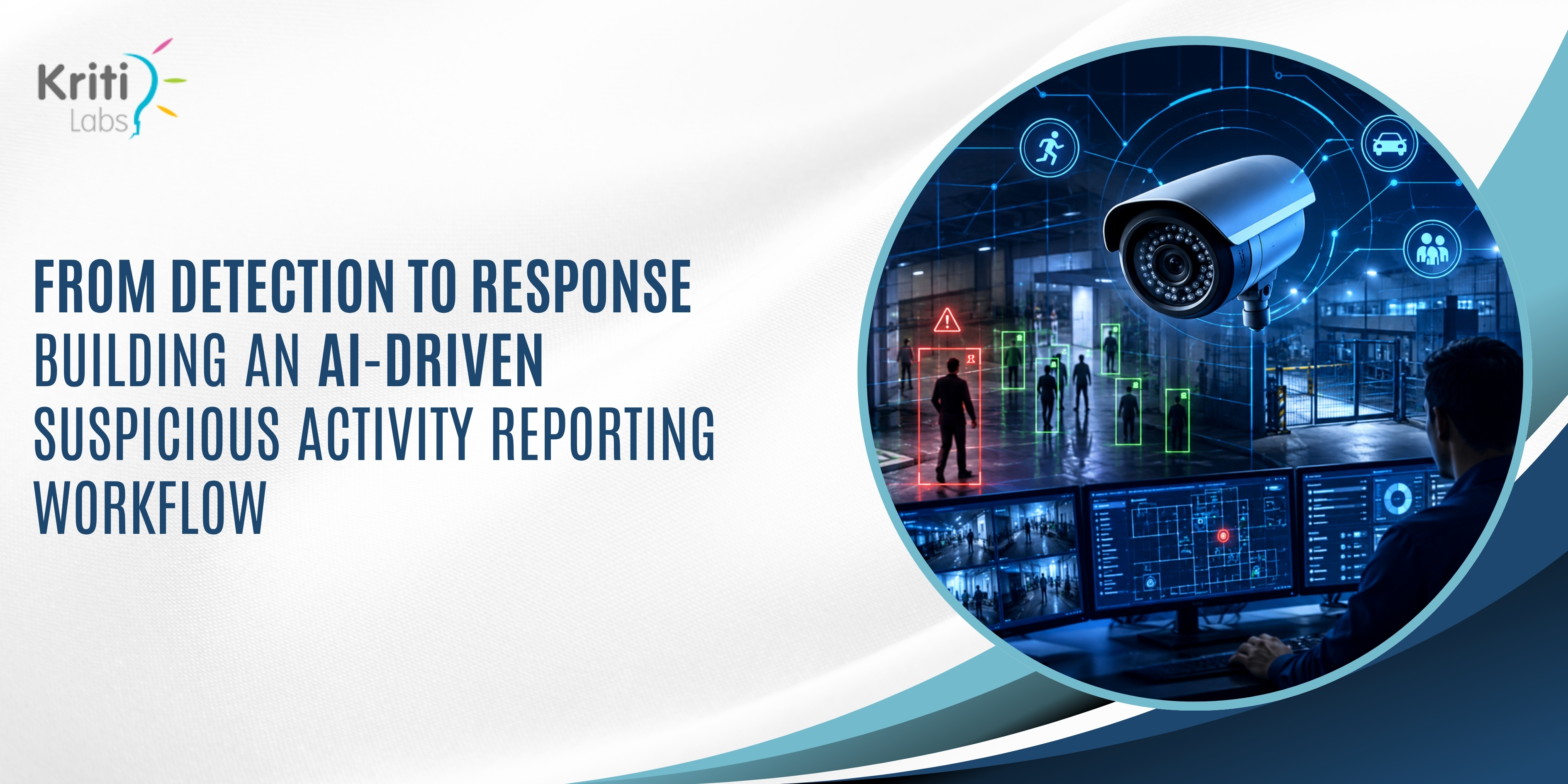
Introduction: The Shift from Passive Monitoring to Intelligent Security
Security monitoring has moved far beyond passive CCTV surveillance. Traditional systems were designed to record events, not interpret them. This meant that security teams often had to manually scan hours of footage, react after incidents occurred, and rely heavily on human judgement.
Today, this approach is no longer sufficient. Modern facilities such as logistics hubs, manufacturing plants, corporate campuses, and smart infrastructure require faster, more accurate, and more intelligent systems.
This is where an AI-driven suspicious activity reporting workflow becomes essential. It transforms security from a reactive process into a structured, real-time decision-making system that moves seamlessly from detection to response.
The goal is simple: identify unusual behaviour quickly, assess its risk level, and trigger the right action without delay.
Understanding Suspicious Activity in Modern Security Environments
Suspicious activity is no longer limited to obvious security breaches. With large-scale operations and complex environments, risk patterns are more subtle and varied.
Common examples include:
- Unauthorized entry into restricted zones
- Loitering in sensitive or low-traffic areas
- Unusual movement patterns near access points
- Tailgating during entry into secured facilities
- Unattended objects in monitored zones
Traditional rule-based systems struggle to interpret these behaviours in context. What may seem normal in one scenario could be a potential threat in another.
This lack of contextual awareness is one of the key reasons organizations are shifting towards AI-based monitoring systems.
Core Components of an AI-Driven Suspicious Activity Reporting Workflow
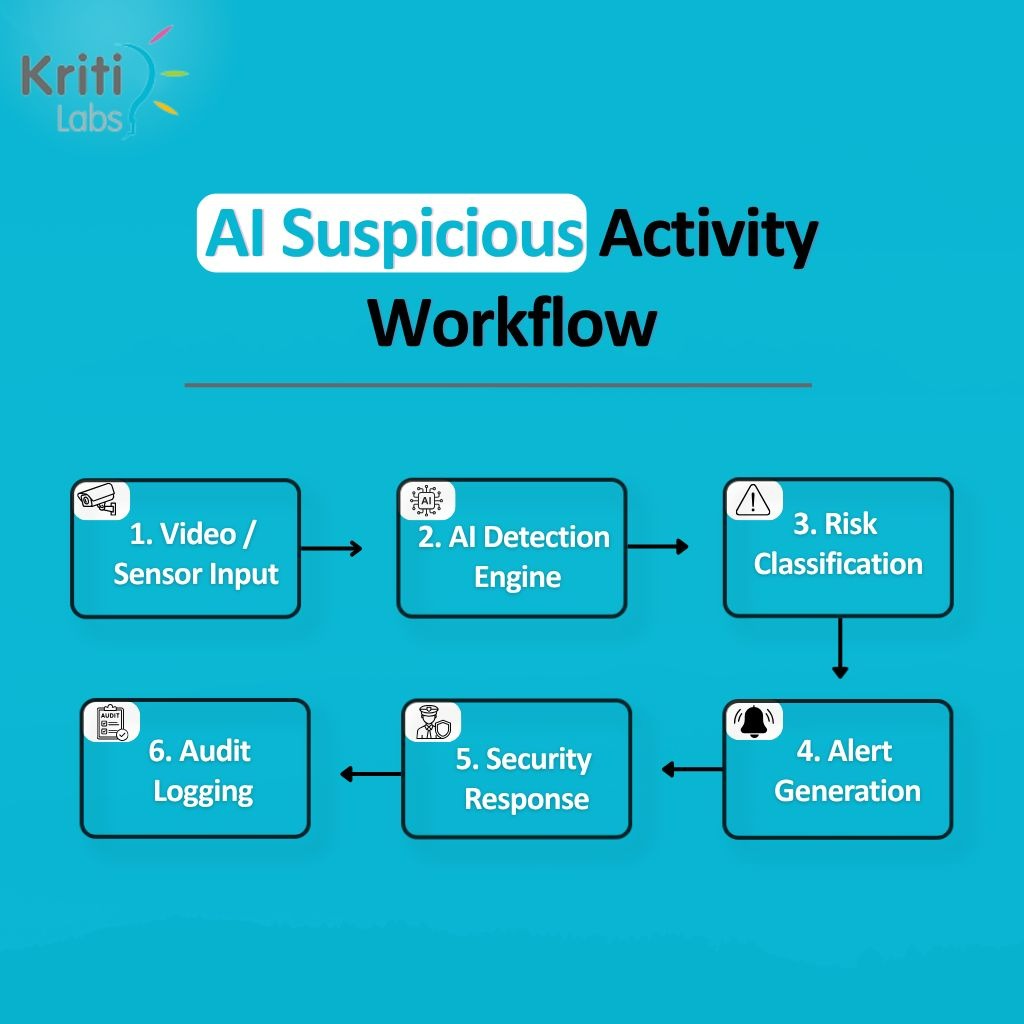
An effective suspicious activity reporting workflow is built on multiple interconnected layers that work together in real time:
- Video surveillance inputs from CCTV and IoT cameras
- AI-powered behaviour recognition models
- Event classification and anomaly detection engine
- Real-time alert generation system
- Centralised security dashboard for monitoring
Each component plays a specific role, but the real value comes from how seamlessly they interact. The system continuously collects data, analyses it, and generates structured responses.
Step 1: Data Capture Through Smart Surveillance Systems
The foundation of any AI security system is data capture. Modern surveillance systems go beyond basic video recording and act as intelligent data sources.
IoT-enabled cameras and sensors continuously stream visual and environmental data from across facilities. These systems capture:
- Movement across defined zones
- Entry and exit activity
- Environmental changes within monitored areas
A key decision in system design is whether processing happens at the edge (near the camera) or in the cloud. Edge processing allows faster response times, while cloud-based systems enable deeper analytics and long-term data processing.
High-quality, uninterrupted data is critical, as it directly impacts the accuracy of AI detection models.
Step 2: AI-Based Detection of Unusual Behaviour
Once data is captured, AI models analyse it in real time to identify abnormal patterns.
This includes:
- Object detection for people, vehicles, and items
- Motion tracking across zones
- Behaviour analysis based on historical patterns
- Detection of anomalies that deviate from expected activity
Machine learning models are trained on large datasets to understand what “normal” looks like in each environment. Anything that deviates from this baseline is flagged for further evaluation.
A major advantage of AI-based detection is its ability to reduce false alarms by considering context rather than relying on fixed rules.
Step 3: Risk Classification and Event Prioritisation
Not all suspicious activity carries the same level of risk. A structured workflow ensures that events are prioritised based on severity.
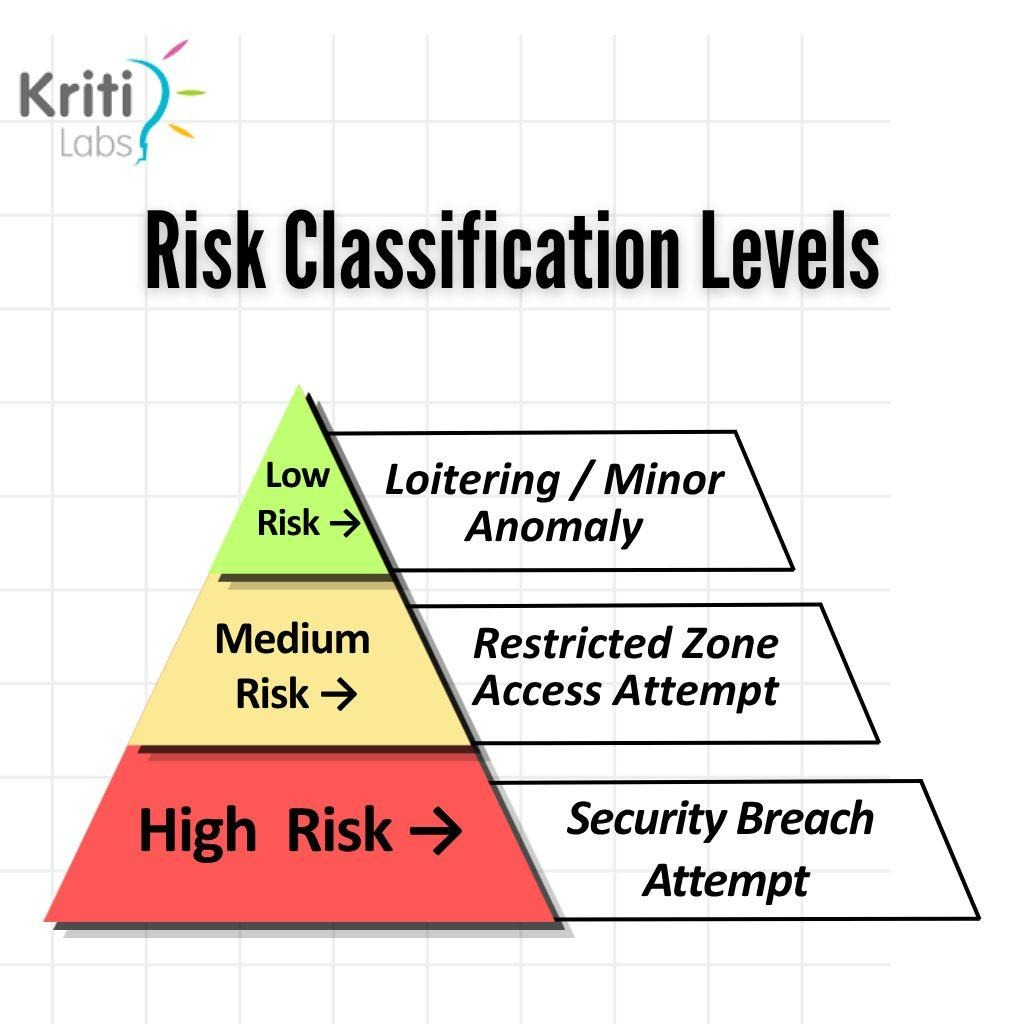
AI systems typically classify incidents into:
- Low risk: unusual but non-threatening behaviour, such as loitering
- Medium risk: access attempts in restricted zones without breach
- High risk: confirmed intrusion or security breach attempt
This classification helps security teams focus on incidents that require immediate attention while filtering out low-impact alerts.
Without prioritisation, monitoring systems can overwhelm operators with excessive notifications.
Step 4: Automated Alerting and Reporting Mechanism
Once an event is classified, the system triggers automated alerts in real time.
Alerts can be delivered through:
- Central security dashboards
- Mobile notifications or SMS alerts
- Control room alert systems
At the same time, the system generates a structured suspicious activity report that includes:
- Event type and severity
- Location and timestamp
- Video evidence snapshots
- AI-generated risk assessment
This removes dependency on manual reporting and ensures consistency in incident documentation.
Step 5: Security Response and Incident Handling
Detection is only effective if it leads to timely action.
In an AI-driven workflow, alerts are integrated directly with security response systems. Depending on severity, actions may include:
- Notifying on-ground security teams
- Triggering alarms or warning systems
- Restricting access through automated gates
- Escalating incidents to central command centres
While AI provides the intelligence layer, human oversight remains important for final decision-making in critical situations.
The combination of automation and human intervention ensures balanced and reliable security management.
Step 6: Audit Trails, Reporting, and Compliance
Every detected and resolved incident is logged into a central system for future reference.
These audit trails serve multiple purposes:
- Supporting forensic investigations
- Assisting in compliance reporting
- Enabling performance analysis of security systems
- Improving AI model accuracy over time
Organizations operating in regulated sectors benefit significantly from structured incident documentation, as it simplifies audits and ensures accountability.
Benefits of an AI-Driven Suspicious Activity Reporting Workflow
Adopting an AI-based workflow offers several operational advantages:
- Faster detection and response times
- Reduced dependency on manual monitoring
- Lower number of false alerts
- Improved situational awareness across large facilities
- Scalable security coverage for multi-site operations
Overall, it shifts security operations from reactive monitoring to proactive threat management.
Challenges in Implementation and How to Overcome Them
While the benefits are significant, implementation requires careful planning.
Common challenges include:
- Integration with existing legacy CCTV systems
- Data privacy and regulatory concerns
- Accuracy limitations in complex environments
- Infrastructure requirements for real-time processing
These challenges can be addressed through hybrid architectures, continuous AI model training, and edge computing solutions that balance speed and scalability.
Real-World Applications Across Industries
AI-driven suspicious activity workflows are being adopted across multiple sectors:
- Logistics and warehousing facilities
- Manufacturing plants and industrial zones
- Smart city surveillance systems
- Corporate campuses and office complexes
- High-security infrastructure such as airports and government sites
Each of these environments benefits from improved visibility and faster incident response.
Future of AI in Suspicious Activity Monitoring
The future of security monitoring is moving towards predictive intelligence.
Instead of reacting to incidents, systems will increasingly:
- Predict suspicious behaviour before it escalates
- Learn continuously from historical data
- Integrate with access control and IoT systems
- Enable fully autonomous security environments
This evolution will further reduce response times and improve overall operational safety.
Conclusion: From Reactive Security to Intelligent Response Systems
The transition from traditional surveillance to AI-driven workflows marks a significant shift in how organisations approach security.
A structured suspicious activity reporting workflow ensures that detection, classification, alerting, and response happen in a seamless, connected manner.
As environments become more complex, the need for intelligent, real-time security systems will continue to grow. Organisations that adopt these systems early will be better positioned to manage risk efficiently and maintain operational continuity.