
Understanding the Shift Towards Cloud-Based Locker Management
As organisations move towards digital-first operations, traditional storage systems are being re-evaluated for efficiency, security, and scalability. Physical keys, manual registers, and isolated locker systems are increasingly proving inadequate in environments where access control, traceability, and user convenience are critical.
Cloud-based locker management is emerging as a modern solution that addresses these challenges. By combining connected hardware, cloud platforms, and intelligent software, organisations gain centralised control, real-time visibility, and enhanced security across all locker assets.
This blog explores what cloud-based locker management is, how it works, why it matters, and how it is shaping the future of secure storage across industries.
What Is Cloud-Based Locker Management?
Cloud-based locker management is a digital system in which lockers are connected to a central cloud platform that manages access, usage, monitoring, and reporting. Unlike standalone locker systems, these platforms enable administrators to remotely control lockers, track activity in real time, and integrate access with enterprise systems.
At its core, the system replaces physical keys and local control units with secure digital credentials and cloud dashboards. Users authenticate using methods such as OTPs, RFID cards, mobile apps, or biometric identifiers, while administrators gain oversight from any authorised location.
This shift from localised locker control to cloud-enabled management allows organisations to scale easily, maintain consistency across sites, and respond quickly to operational or security events.
Why Traditional Locker Systems Are No Longer Enough
Conventional locker systems were designed for static environments with limited user movement and low security risk. In today’s dynamic operational settings, these systems introduce several challenges.
Manual key handling often leads to loss, duplication, and unauthorised access. Paper-based logs are error-prone and offer limited accountability. Isolated locker systems across different locations create silos, making it challenging to enforce consistent policies or audit usage.
As organisations grow and adopt flexible work models, shared facilities, and multi-site operations, these limitations become increasingly visible. Cloud-based locker management directly addresses these gaps by introducing automation, transparency, and control.
Traditional Lockers vs Cloud-Based Lockers
| Aspect | Traditional Lockers | Cloud-Based Lockers |
|---|---|---|
| Access Method | Physical keys | OTP, RFID, mobile app, biometric |
| Visibility | No real-time visibility | Live status and usage tracking |
| User Management | Manual allocation and tracking | Centralised user management via cloud dashboard |
| Audit Trail | Manual registers | Automatic digital logs and tamper-proof audit trails |
| Maintenance | Manual inspections and key management | Remote diagnostics and system health monitoring |
How Cloud-Based Locker Management Works
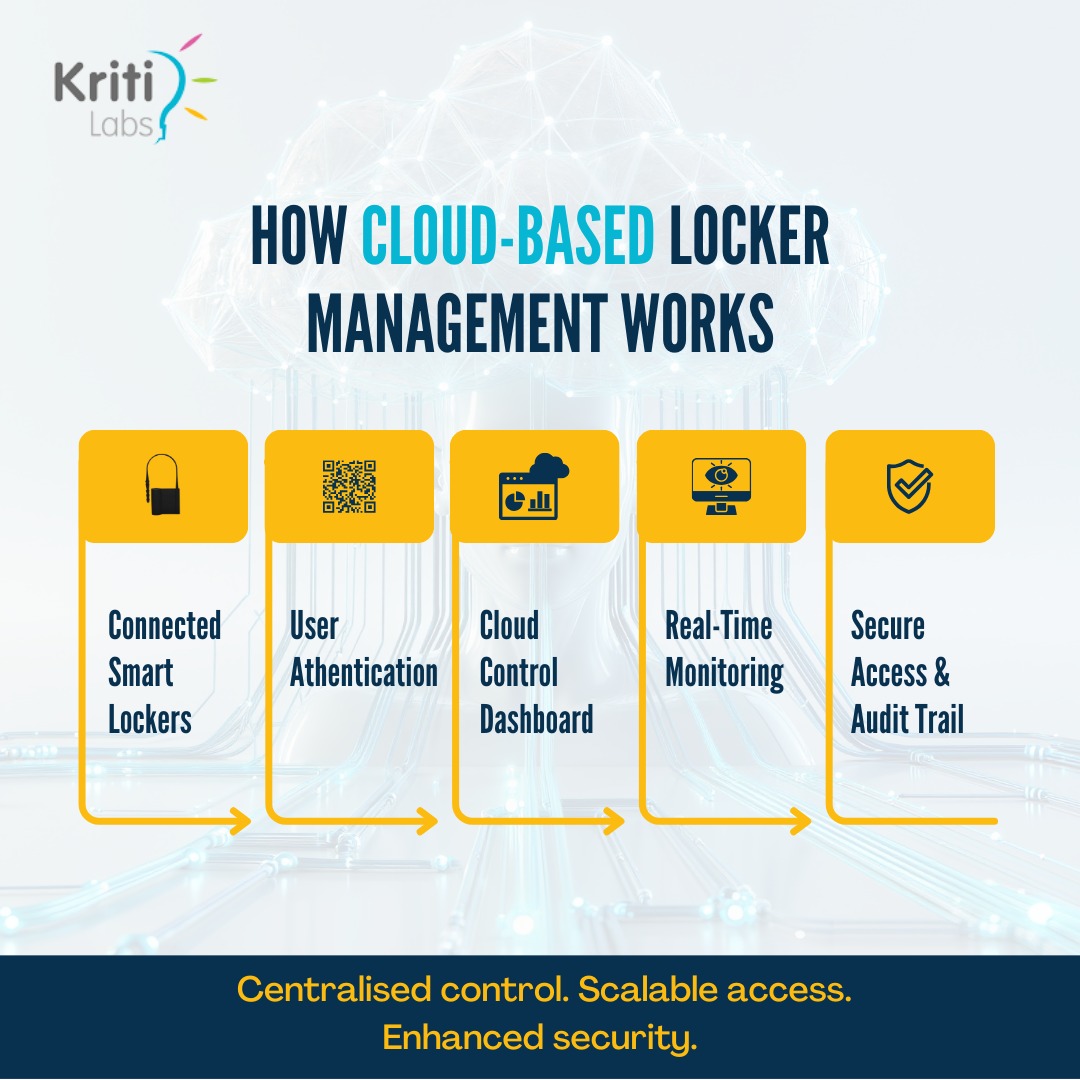
A cloud-based locker management system typically consists of three core components.
First, the locker hardware is fitted with electronic locks and connectivity modules. These allow the locker to communicate securely with the cloud platform.
Second, the cloud software acts as the central control layer. It manages user access, authentication rules, time-based permissions, and system configurations. Administrators can assign lockers, revoke access, and monitor activity through a web or mobile dashboard.
Third, user authentication methods enable seamless access. Depending on the environment, this could include mobile OTPs, access cards, QR codes, or biometric verification.
When a user attempts to access a locker, the request is verified in real time by the cloud platform. Every interaction is logged automatically, creating a detailed and tamper-resistant record.
Key Benefits of Cloud-Based Locker Management
Centralised Control Across Locations
One of the most significant advantages is centralised control. Organisations with multiple offices, warehouses, or facilities can manage all lockers through a single platform.
This eliminates the need for local administrators at each site and ensures uniform access policies. Centralisation also allows faster response to incidents. Access can be disabled instantly if credentials are compromised or if a user leaves the organisation.
Enhanced Security and Accountability
Cloud-based systems offer stronger security than traditional locker setups. Digital authentication reduces the risk of unauthorised access, while activity logs provide complete traceability.
Every locker interaction is recorded, including user identity, time, and access duration. This level of visibility is particularly valuable in regulated industries or high-risk environments.
Improved User Experience
For end users, cloud-based locker systems remove friction. There is no need to manage physical keys or wait for manual approvals. Access is faster, more reliable, and often integrated with existing identity systems.
This convenience improves adoption and reduces administrative workload, especially in high-traffic environments such as offices, gyms, or public facilities.
Scalability and Flexibility
As organisations expand, cloud-based locker management scales easily. New lockers can be added without redesigning the entire system.
Access rules can be centrally updated, and temporary permissions can be granted to visitors or contractors. This flexibility makes cloud-based systems suitable for both permanent installations and evolving operational needs.
Role of Cloud Technology in Secure Storage
Cloud infrastructure plays a crucial role in making locker management more reliable and resilient.
Data is stored securely with redundancy and encryption, reducing the risk of loss or tampering. Updates and feature enhancements can be rolled out without physical intervention, keeping the system up to date.
Cloud platforms also enable analytics. Usage patterns, peak access times, and underutilised lockers can be identified, helping organisations optimise space and resources.
Industry Use Cases for Cloud-Based Locker Management
-
Cloud-based locker systems are finding adoption across a wide range of sectors.
In banks and NBFCs , cloud-based lockers are used to securely manage customers' valuables, documents, and internal assets. Digital access control, audit trails, and centralised monitoring help financial institutions improve security while simplifying compliance and branch-level operations.
In jewellery stores and vault facilities , cloud-enabled lockers help protect high-value inventory and customer assets. Role-based access, time-stamped logs, and remote monitoring reduce manual dependency and improve accountability across multiple locations.
In corporate offices, they support flexible seating, shared storage, and hybrid work environments. Employees can reserve lockers dynamically, while administrators manage access centrally.
In logistics and transportation, lockers secure documents, devices, and equipment at transit points. Access records help maintain the chain of custody and accountability.
In manufacturing and industrial facilities, lockers store tools, safety gear, and sensitive materials. Cloud-based access ensures only authorised personnel can retrieve assets.
Integration With IoT and Smart Systems
Cloud-based locker management often works alongside IoT technologies. Sensors can detect door status, tampering attempts, or environmental conditions such as temperature and humidity.
When integrated with broader facility management or security platforms, lockers become part of a connected ecosystem. Alerts can be triggered when lockers are forced open or left unattended, enabling proactive security management.
Compliance, Audits, and Reporting
For organisations operating under strict compliance requirements, cloud-based locker systems offer clear advantages.
Automated logs eliminate manual recordkeeping and reduce human error. Audit trails are readily available and can be filtered by user, location, or time period.
Reports can be generated to demonstrate compliance with internal policies or external regulations, saving time during inspections and audits.
Cost and Operational Efficiency
While cloud-based locker systems may require a higher upfront investment than traditional lockers, they often deliver long-term savings.
Reduced administrative effort, lower risk of loss or theft, and improved space utilisation contribute to operational efficiency. Centralised management also lowers maintenance and staffing costs.
The Future of Secure Storage
The future of locker management is closely tied to digital transformation. Cloud-based platforms will continue to evolve with features such as AI-driven usage forecasting, deeper identity integration, and predictive maintenance.
As organisations prioritise security, transparency, and user convenience, cloud-based locker management is likely to become the standard rather than the exception.
Conclusion
Cloud-based locker management represents a significant shift in how organisations think about secure storage. By combining connected hardware, cloud platforms, and digital access control, it delivers higher security, better visibility, and improved user experience.
As operational environments grow more complex, the need for scalable, intelligent, and transparent storage solutions will only increase. Cloud-based locker management is well-positioned to meet these demands and define the future of secure storage.
Frequently Asked Questions (FAQs)
1. What is cloud-based locker management?
Cloud-based locker management is a digital system that uses cloud software to manage, monitor, and control lockers remotely. It enables real-time access control, user authentication, usage tracking, and centralised administration without manual intervention.
2. How is cloud-based locker management more secure than traditional lockers?
Unlike traditional lockers that rely on physical keys or static codes, cloud-based locker management uses digital authentication, access logs, and role-based permissions. This reduces risks such as key loss, unauthorised access, and lack of visibility into locker usage.
3. Which industries benefit most from cloud-based locker management systems?
Industries such as offices, co-working spaces, manufacturing units, logistics hubs, educational institutions, hospitals, and smart cities benefit significantly. Any organisation that requires shared, flexible, and secure storage can adopt cloud-based locker management.
4. Can cloud-based locker management integrate with existing systems?
Yes, most cloud-based locker management systems can integrate with existing access control systems, employee ID cards, mobile apps, and enterprise software. This allows organisations to manage lockers as part of a broader digital infrastructure.
5. Is cloud-based locker management scalable for large organisations?
Cloud-based systems are highly scalable. Organisations can easily add new lockers, locations, or users without major infrastructure changes, making them suitable for both small setups and large multi-location enterprises.